Showing posts with label newspaper. Show all posts

Sunday, April 30, 2017

"IT'S NOT STEVE FAGAN'S PAPER ANYMORE"

Four years ago today -- on April 30, 2013 -- I retired from newspapering after a 45-year-career that began with a post-Navy reporting job at the New Albany (Ind.) Tribune in 1977 and ended with an 11-year and 8-month run as editor of The Monitor here in McAllen, Texas. Along the way I worked at reporting and various editing jobs at nine newspapers ranging from major metro to mid-sized dailies in seven different states.

This morning, it seems somehow fitting the fourth anniversary of my retirement comes the day after the White House Correspondents' Dinner in Washington that was boycotted by America's so-called president, Donald Trump. It was an event keynoted by speeches by Carl Bernstein and Bob Woodward the two Washington Post reporters whose Watergate reporting led to the resignation of President Richard M. Nixon. They were introduced as two reporters whose work inspired a generation of American Journalists.

I was one of them.

As they spoke, I could not help but reflect on where American Journalism rose to in the wake of their Watergate work and where it has descended to today, something that has troubled me seriously since well before I retired as I watched the newspaper industry withering.

Many of my former newspapering colleagues along with newspaper industry critics and analysts say the newspapers are dying because they are an outmoded medium that readers are abandoning. I, however, have long disagreed with that assessment, contending instead that newspapers aren't dying, they are committing suicide and continue to lose readership not because readers are abandoning them but rather because they have abandoned readers.

Proof of my theory is quite evident with this morning's edition of the final newspaper that I had been editor of, The Monitor.

As editor, I always felt that the Sunday edition -- the highest circulation paper of the week -- should be a showcase with a front page featuring at the very least one well-planned, primary story package that was investigative or interpretive or analytical in nature and always an in-depth piece with photos or illustration or graphics and always of real and serious importance to and impact upon readers. It was a philosophy my staff always shared and executed throughout my tenure as editor even as the company that owned the paper -- Freedom Communications -- slipped into bankruptcy and was taken over by investment bankers interested only in profits who gutted our budget and forced me to reduce staff by nearly half -- fortunately, mainly through attrition rather than any large layoffs. In the end, the paper was sold -- along with Freedom's other Texas papers -- to its current owners.

Today, only seven members of the news staff that was at the paper when I departed remain and only one staffer remains who was there when I arrived for my first day at the Monitor on August 27, 2001. At its peak that news staff numbered 53 people, many of whom -- because of their talent and hard and outstanding work at The Monitor -- have gone on to bigger and better things at some of the nation's top major metro dailies or highly respected, and REAL online news sites and at least one having a piece of two separate Pulitzer Prizes.

Some my former staffers, who have now no longer with The Monitor, told me a couple of months after my departure that after they mentioned to my successor that something wasn't being handled the way it would have been while I was editor, he told them (quite correctly) that "this isn't Steve Fagan's paper anymore."

And that was quite evident in today's fourth anniversary of my retiring from newspapering edition of The Monitor.


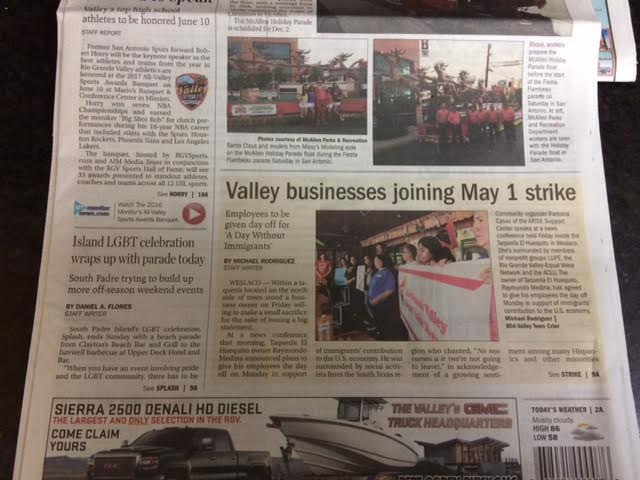
The main story package was not an in-depth investigative, interpretive or analytical piece, but rather at five-paragraph, five-inch-long, "Staff Report" story revealing that a float normally featured in the McAllen Christmas Parade had been carted up to San Antonio for the 2017 Fiesta Flambeau Parade. The story -- which read pretty much like a press release -- was accompanied by three really bad (and badly reproduced) handout photos provided "courtesy of McAllen Parks & Recreation" department. In Steve Fagan's Monitor, this would have been a single photo and cutline probably inside the Valley & State section, but certainly NOT on the main package on Page 1.


One of the other three Page 1 stories -- also bylined as a "staff report" -- announced that former San Antonio Spurs forward Robert Horry would be the keynote speaker at the 2017 All-Valley Sports Awards Banquet, an even sponsored by The Monitor and its parent company AIM Texas Media, which also owns the Brownsville Herald, El Nuevo Heraldo, the Valley Morning Star in Harlingen and the weekly Mid-Valley Town Crier.

A third story was a piece headlined "Island LGBT celebration wraps up with parade today." This  story had some promise particularly if it had dealt, at least somewhat, with the issue of LGBT discrimination in Texas -- which has long been pretty rampant -- and where it stands as we rapidly descend into becoming Donald Trump's bigoted America. It could have featured, maybe, some interviews with actual participants in the event and their feelings on where things are headed with LGBT rights, etc. It, however, didn't and ended up reading more like a South Padre Island Chamber of Commerce press release.


The last story on the page, headlined "Valley businesses joining May 1 strike," had the most potential. In fact, in terms of its topic, it could have been the main story package for the Sunday paper. But it fell woefully short because, apparently, no one recognized its potential for being something better than it was or, if they did recognize that potentially, they simply didn't care enough to push to develop it. Hispanic organizations across the United States are calling for a nationwide "Day Without Immigrants" (Una dia Sin Immigrantes) strike to call attention to the importance of immigrants in the United States' society and economy and to decry the immigration policies and attitudes of Donald Trump, his administration and the Republican controlled Congress. This could have been a meaningful, Valley wide story that took a serious look at immigrants and the roles in America. This area, after all, is something like 90+ percent Hispanic in population and tens of thousands of people here are immigrants both legal and undocumented and hundreds of thousands are descendant of immigrants. Here, a strike by a significant number of immigrants and their supporters who grind everything to a complete standstill. This story could have explored how many area businesses are going to support their employees' participation in the strike and how local government officials, chambers of commerce, schools, the University of Texas Rio Grande Valley, South Texas College, etc. view the strike. The story could have included interviews with workers, students, etc. who are planning to participate in the strike and what message they are hoping it will send and what good they think it might actually accomplish. It could have been a very strong Sunday package including photos of the anticipated participants, perhaps with strike placards they are making or have already prepared. But to have carried that off would have required that someone be awake at the switch, which didn't happen. The story instead was simply coverage of a press conference in which two businesses said they are supporting their workers who might want to participate in the strike -- a disappointing piece full of unrealized potential.

Essentially, the Sunday edition of The Monitor, published on the fourth anniversary of my retirement from newspapering had a front page that gave readers absolutely no reason to pick it up off the lawn and certainly no reason to buy a single copy newspaper off a rack. And a such is unfortunately way too representative of what's wrong with too many newspapers today.


Yep, "it's not Steve Fagan's paper anymore."


-30-


Friday, June 24, 2016

A 45-YEAR NEWSPAPER CAREER IS CHOCK FULL OF SOUVENIRS, MEMORIES THAT CAN'T BE BOUGHTEN

In his song "Souvenirs" the late, great Chicago folk singer, songwriter Steve Goodmam came up with this in his lyrics:
   
     Memories, they can't be boughten
     They can't be won a carnivals for free
     Well, it took me years
     To get those souvenirs
     And I don't know how they slipped away from me

Well, I was in the garage earlier this week weeding through boxes of sourvenirs from my 45-year career in newspaper newsrooms -- with the intent of getting rid of stuff I really didn't want -- when I came across a picture frame containing a white name tag enclosed in a clear, plastic sleeve with a swatch of red ribbon attached and a purpling with age 3 x 5 photograph of three guys in tuxedos, each with a name tag and red ribbon pinned on them. The ribbon has gold leaf on it reading "DSA (Distinguished Service Award) Winner." Here is the photo: 


The three tux-clad mokes are (from left to right): Me, then assistant managing editor; Mark Thompson, then Washington Bureau reporter; and the late Jack Tinsley, then executive editor of the Fort Worth Star-Telegram.

The photograph was shot in 1985 in Salt Lake City where Mark, Jack and I had just picked up the Society of Professional Journalists national Distinguished Service Award for Public Service in Journalism. The newspaper won the award, one of American journalism's most prestigious, for Thompson's incredible five-part series detailing a design defect in the Cobra and Huey helicopters that Fort Worth-based Bell Helicopter built for the U.S. military. The series revealed that the company had known about the design defect for years and had a fix for it but did not correct it even though it had apparently been responsible for the loss of many choppers, costing the lives of numerous GIs, particularly during the Vietnam War. As a result of the work by Thompson, who now reports on the military for Time Magazine, all of the U.S. military's Bell Cobra and Huey helicopters were grounded and retrofitted with a device that corrected the design defect.

Naturally, finding the the picture frame with this souvenir ribboned name tag and aging photo kicked off a wave of memories.

During my 45-year newspaper career, the Bell Helicoter series was one of the finest pieces of journalism I was ever associated with, had the privilege of editing and, as it turned out, defending in the face of demands from Bell's top officials that the series be halted and that Thompson and I be fired -- him for pursuing and writing it and me for being responsible for its oversight and publication. Ahhhhhh, yes, those were the days. Incidently, the series went on to win the Pulitzer Prize for Public Service and several other major national awards that year.

The first part of the series was publish on Sunday, Mar. 25, 1984. By the time Monday morning rolled around, after publication of the second part, the angry phone calls from officials and employees at Bell -- then Fort Worth's single largest employer -- had reached a fever pitch. When I walked into my office shortly after 9 that morning, I was greated by phone and written messages inviting me to Jack Tinsley's office immediately.

Jack informed me that Jack Horner, the president of Bell Helicopter, had called him after trying unsuccessfully to contact Publisher Phil Meek, who was, I think, out of town on business. Tinsley told me that Horner was demanding that the series be halted immediately and that the paper issue an apology to Bell and that Thompson and "the editor responsible for publishing" the series be fired. Tinsley told me that he had left a message for Meek to call him ASAP so they could consult on Horner's demands and he said there was certainly chance the I might lose my job.

Meek finally called back and Jack -- with his phone on speaker and me sitting there across from his large cluttered desk -- told the publisher about the rising storm from Bell and its employees and about Horner's call and demands. Phil assured Jack that he did not want to halt what might be one of the paper's best-ever jounalism efforts and that neither Mark nor I would be fired.

"Well, what do I tell Jack Horner," Tinsley asked. Without hesitation, Meek replied: "Tell Horner to go fuck himself."

So, moments later, and still on speaker phone with me sitting there, Tinsley called Horner back.

"I talked to Phil Meek about your demand that we halt the series, publish an apology to Bell and fire Mark Thompson and Steve Fagan, the editor responsiblefor publication of the series," Tinsley told Horner.

"Well, what did Phil have to say," Horner asked with icy smugness.

"He said for me to tell you to go fuck yourself," said Tinsley. A Loud click came over the speaker followed by the dial tone. Tinsley hung up his receiver, and turned toward me with a big grin on his face and suggested I get back to my office because I was probably going to have a lot of phone calls to answer.

Before I could get back to my office, however, Circulation Director Jim Tingle -- an ex-paratroop officer who stood about a head and a half taller than me -- cornered me in a hallway and angrily backed me into a corner.

"What the hell do you think you're doing? Do you now how many cancellations we've had this morning already," he asked with a glaring red face. "More than 300 and that's just for starters."

He then informed me that officials at the Bell plant had pulled all of our circulation boxes off the property and tossed them outside the main gate and the off-work Bell employees were planning to show up and picket outside the newspaper building after lunch (which they did).

Tingle then demanded to know "why the hell are we running this story and did anybody consider what kind of problems it would cause" for his department.

I blurted out that we were running it "because it's a great piece of Journalism."

"Oh, yeah," he responded. He then drew the thumb, index and middle finger of his right hand tightly together and used them to pound on my sternum with each word as he growled emphatically: "Well, if it's such a goddammned great piece of journalism, why wasn't it in the New York Times or Washington Post first." With one final snort, he stormed off leaving me shaken and my sternum bruised.

Once the flood of memories subsided, I decided to post the photo on Facebook. It almost immediately started drawing "likes" and comments -- lots of them -- from my, Mark's and Jack's mutual and individual friends.

Among the comments, the one that surprised and touched me most came from Phil Meek, who has Mark as one of the select few people he has friended on Facebook. During my newspaper career I was fortunate to have worked for several pretty good publishes including Barry Bingham Sr. and Barry Bingham Jr. at The Louisville Courier-Journal and Times, and Olaf Frandsen and Ray Stafford at The Montior here in McAllen, Texas. But I think, perhaps, the best publisher I ever worked for was Meek because unlike the others who came up with a newspaper background, Meek come to the business from the automobile industry. However, he seemed to have an innate understanding of the role and responsibility of the press in general and newpapers in particular.  As publisher he seemed absolutely fearless and was 100 pecent supportive of his newspeople, putting his full faith and trust in their work until they were proven beyond doubt to be wrong. He seemed to truly believe that the purpose of a newspaper was to comfort the afflicted and afflict the comfortable.

In his comment, Phil wrote regarding the photo:

"It was so appropriate that by his presence Steve was recognized for his largely unheralded work behind the scenes that helped Mark's four part (actually five part) investigative series lead to the awarding of the Granddaddy of the Pulitzers, the Gold Medal to the Fort Worth Star-Telegram for Distinguished Public Service in May 1985."

Appreciating that sort of comment from a publisher I greatly admired, it replied with this:

PHIL: Editor's seldom get publicly heralded for their behind the scenes work and editing of fine pieces of reportage. That, rightfully goes to the reporters who have to bust their butts and often even put their personal safety on the line to piece together the information that makes up a good story or series and then write it in a form an editor can grasp and hone. Editors, the good ones, take their pleasure from seeing the people they supervise doing good journalistic work and knowing that, in part, their directing, influence and encouragement have an impact on that work. As far as the Bell Helicopter series was concerned. I felt I got all the heralding I needed from the people whose heralding really mattered most to me -- you, Mark, Jack, my colleagues at the Star-Telegram and from those who had worked for or with me at other papers who knew and understood that this was one of the finest examples ever of the kind of journalistic efforts I tried to promote and encourage my staffers to engage in.


-30-


f you enjoy reading my blog, please share it and its link with your friends and colleagues.

********
I sure would appreciate if you'd consider subscribing to or following the blog. It's easy to do and there are several options for doing so. If you look on the right side rail, you'll see the "Subscribe to" buttons and a "Subscribe by email" button. Just click any of those and follow the instructions. If you are a Google+ user you can click on the "Follow" button right under my profile picture and follow the instructions. Or, you can click on the "Google+ Add to Circles" button next to my photo and add me to your circles and get notifications of new blog entries when I post them. Thanks for giving this consideration.


As always, your thoughts and/or comments are welcomed.


Thursday, May 7, 2015

ARE COWS BECOMING TOO SACRED FOR TOO MANY OF TODAY'S TROUBLED NEWSPAPERS?

My friend Michael H. Price, who I worked with many years ago at the Fort Worth Star-Telegram, posted this provocative early 20th Century cartoon, by socialist editorial cartoonist Art Young, depicting the newspapers of the time as brothels:


With the posting, Mike wrote: "The newspaper racket as a brothel. True enough at the start of the 20th Century, when Art Young published this cartoon, and truer in the Great Here & Now. Exceptions all along, of course, but fewer and fewer exceptions. Too much Bread & Circuses, and nowhere near enough provocative substance."

I really wish I could disagree with Mike, but, frankly, I think the sentiment expressed in this cartoon is just as accurate today -- with newspapers continuing to suffer financial hardships due to declining advertising revenues -- as it probably was then. Perhaps even more so.

I've touched on this topic before, in my Feb. 13, 2015, post "NEWSPAPER ETHICS: MAINTAINING (OR NOT) THE LINE BETWEEN DOLLARS AND SENSE," which you will find still available among my older blog posts.

Many of today's papers have seemingly accorded "scared cow" status to large local advertisers -- who seem to have no qualms about using the weight of their advertising dollars to bully publishers and editors -- and to prominent local people, business leader and particularly vocal groups in their communities who raise objections to certain kinds of content.

Once upon a time, back when newspapers were making higher profits than almost any other industry in the United States, most reputable newspapers took great pride in contending they had no sacred cows.

Prominent among those newspapers was afternoon Louisville Times -- where I took my first, post-college reporting job in 1970 -- and its morning sister publication, The Louisville Courier-Journal. But even then and even there, the "no sacred cows" contention wasn't exactly true as I learned when I wrote a story about Democrat Louisville Mayor Dr. Harvey I. Sloane not paying several years worth of a state tax (the exact title of which I can no longer recall) that applied only to those who, like Sloane, were extremely wealthy.

I knew Sloane was good friends with the also very wealthy Bingham family, owners of the papers at the time, who had thrown their full and the newspaper's full support behind his bid to become mayor.

By the time I turned in the story to the city desk the evening before it was to be published in the next afternoon's paper, I had all of my facts confirmed and double checked and even had the mayor acknowledging that he'd "overlooked" the payments due under the tax and his promise that he would immediately make good on what he owed.  My editors and I figured that with all of this nailed down, the cozy relationship between the Binghams and the mayor wouldn't matter when it came to publishing a story about him being significantly delinquent -- we're talking many tens of thousands for dollars delinquent (over the intervening 40 some years I can't recall the exact amount, but I think is was something like $72,000 and change) -- in the payment of any rightfully owed tax.

We were wrong.

When my story was published in the day's first edition, it appeared stripped six-columns across the top of the front page under a large headline that said something like "Mayor fails to pay $72,000 in taxes."

When copies of the first edition hit Publisher Barry Bingham Jr.'s desk, our managing editor, apparently got a call from Barry Jr. raising cain over the story.

As a result, in the day's second edition, the story was moved to the bottom of the page, with the same headline. But that apparently didn't salve Barry Jr.'s state of pisstivity. He didn't want the story on Page 1, period. In addition, Bingham contended that the story was minimalized by my high-up sentence explaining that the particular tax Sloane owed only applied to the very wealthy.

So, by the day's final edition, the story had been moved to a page deep inside the local section under the headline "Mayor fails to pay obscure tax."

As a reporter and then editor at other newspapers where I worked throughout most of the rest of my more than 44 year career, I encountered similar experiences, even though most of those papers also took great pride in saying they had no sacred cows.

Of course, I did enjoy and number of instances where advertisers or prominent individuals and/or business leaders were told that their dollars or their influence were not going to interfere with the publication of valid news stories.

One such instance occurred while I was assistant managing editor for news and projects at the Fort Worth Star-Telegram in connection with the Bell Helicopter series that went on to win the 1985 Public Service Pulitzer Prize. The series dealt with a design flaw in some of the helicopters that Fort Worth-based Bell Helicopter built for the U.S. military. In the five-day series, Washington Bureau Reporter Mark Thompson revealed the design flaw -- which led to an in-flight phenomenon called "mast bumping" -- had caused the deaths of nearly 250 service men between 1973 and 1984 and that it had gone uncorrected even after Bell's chief attorney brought it to the attention of company executives in 1979 and recommended the problem be fixed immediately.

The series, which began its five-day run on Sunday, March 25, 1984. enraged Jack Horner, president of Bell, which was the city's single largest employer. On Monday morning the furious Horner called to speak to Publisher Phil Meek, who was out of town. So he settled for screaming over the phone at Executive Editor Jack Tinsley, demanding the series be immediately halted, that the people responsible for it be immediately fired and that a top-of-the-front-page apology to Bell Helicopter be published across six-columns of the Tuesday paper, or else.

Tinsley called me -- as the editor responsible for overseeing those who produced and did the primary editing on the series and for actually putting it in the paper -- into his office. Frankly, I fully expected to be fired.

However, Tinsley told me he had reached Phil Meek by phone and informed him of Horner's demands.

"I asked him what I should tell Horner and Phil told me to tell Horner to go fuck himself. So, that's pretty much what I did," Tinsley told me. Although, by that afternoon, all of our single-copy sales boxes on Bell property had been ripped up and tossed outside the plant gates and a group of Bell employees had begun picketing outside the newspaper, the series continued and my job, Thompson's job and job of State Editor Roland Lindsey, who directly oversaw Thompson, were safe. Here is a link to the stories that were part of the series, which I still think is one of the finest examples of quality American journalism: https://sites.google.com/site/mthompsondc/star-telegramseries.

Considering the financial condition of most newspapers, I wonder how many of today's publishers would come up with that sort of response to livid complaints from an important advertiser, business leader or heavy hitting employer.

I fear the answer is not very many.

Certainly, during the waning years before my retirement as editor of The Monitor in McAllen, Texas, and departure from the newspaper business, I experienced several incidents in which important local advertisers where allowed to directly browbeat me, call me unethical and irresponsible and even accuse me or one or more of my reporters of taking payoffs during meetings called to let them bitch about things published in the newspaper that they didn't like.

And, as I communicate with editor and reporter friends who still are employed at other newspapers around the country, I hear more and more tales of such incidents in which outside influencers are allowed to successfully interfere with what gets published in their papers. The main reason usually being cited is fear of lost advertising revenue. The consequence, valid and important news stories with, as my friend Mike Price put it, "provocative substance" -- and even online comments from readers on some stories that do get published -- are being thwarted.

The result: As more of these sorts of things happens, readers lose faith and trust in their newspaper, which loses relevance for them. And we all know what happens when people no longer feel their newspaper is relevant in their lives.

-30-

*******

If you enjoy reading my blog, please share it and its link with your friends and colleagues.

********
I sure would appreciate if you'd consider subscribing to or following the blog. It's easy to do and there are several options for doing so. If you look on the right side rail, you'll see the "Subscribe to" buttons and a "Subscribe by email" button. Just click any of those and follow the instructions. If you are a Google+ user you can click on the "Follow" button right under my profile picture and follow the instructions. Or, you can click on the "Google+ Add to Circles" button next to my photo and add me to your circles and get notifications of new blog entries when I post them. Thanks for giving this consideration.

As always, your thoughts and/or comments are welcomed.


Thursday, April 30, 2015

TWO YEARS INTO RETIREMENT, THE NEWSPAPER-CAREER MEMORIES, GOOD AND BAD, STILL FLOW

As I approached this day, April 15, 2015, the second anniversary of my retirement after nearly 12 years as editor of The Monitor in McAllen, Texas, and at the end of a more than 44-year career in the newspaper business, a flood of disjointed memories has been washing over me -- many wonderful and others not so much.

Over the past two years, the thing that has surprised me most is that I haven't really missed the job nearly as much as I thought I would. This impresses me as quite odd since I always regarded newspapering as more of a way of life than just a job. It was, at least for most of my career, something that you invested yourself in even though you knew that no matter how much you loved a newspaper, it would never love you back, and that as places to work, all newspapers sucked, but many sucked much worse than others.

Before I retired, I used to frequently say the once I did step out of the business I expected to die within three months from lack of stress.

Well, here it is, two years later, and I'm still here and what remains of the business for me is my memories, weird highlights of which have been almost magically washing over me since Tuesday.

It think that what sparked my Magical Mystical Memory Tour was a photo that popped up Tuesday on my Facebook timeline under the heading (oddly enough) of "Your Memories." It was a post I had put up on April 28, 2013, two days before my retirement. The post consisted of a photo of my barren-looking office at The Monitor after I had carted off about eight to 10 boxes of my personal stuff and a cutline. Here is what I had written:

"The only personal possessions now remaining in my office at The Monitor are my Monitor coffee mug, a few packets of sweet n low and what remains in the bottom of a Coffeemate container. Oh yeah, and 11 years and nine months of mostly great memories."

And, here's the photo:


Then, several hours later on Tuesday, the wonderfully witty Michael H. Price, who had been a feature writer and reasonably renowned film critic at The Fort Worth Star-Telegram before, during and after my tenure there -- first as business editor, then assistant managing editor-news and projects and finally night managing editor -- put up a Facebook post that drew comments from a number of former Starlegram staffers, many of them also named "Mike" or "Michael."

That immediately brought to mind the fact that will I was at the Star-Telegram, I was impressed at the overabundance of Mikes in the news department. There was not only Mike Price, but also, to name just a few, Mike Perry, Mike Strickland, Mike Gerst, Mike Norman. Here a Mike, there a Mike, everywhere a Mike, Mike.

I recalled thinking the if I walked into the newsroom and screamed "MIKE," more that half of the guys would look up, including even Sports Editor Jimmy Walker, who may not have been a "Mike" but sure as hell wouldn't want to miss out on a share of anything good that might be coming the way of the Mikes.

That was the first of the disjointed memories that have been coming not so much as long, drawn out episodes, but rather as quick and sometimes, often downright weird, snapshots of a more than 44 year career of doing something I truly loved.

Here is just small fraction of the other career recollections that have been rumbling in my head since Tuesday:

In another Star-Telegram memory, I recalled a mid-April 1985 afternoon huddled in the paper's small "wire room" with Executive Editor Jack Tinsley, Assistant Executive Editor Phil Record and several others as our news service teletypes clickety clacked away while we nervously awaited word on the winners of that year's Pulitzer Prizes.

Although the winners are supposed to be secret until actually announced by the Pulitzer Board, there always seems to be leaks. Two days before, I had been informed by two "sources" that Star-Telegram Washington Correspondent Mark Thompson was to be awarded the Investigative Reporting Pulitzer for his series revealing that at least 250 U.S. service men had lost their lives due to a design flaw in Bell helicopters built in Fort Worth for the military.

I was more nervous than any of the other assembled editors because I had relayed the information from my sources to Publisher Phil Meek, who had enough faith in what I'd told him to set in motion a plan for a celebration costing thousands of dollars.

That morning, however, I got calls from both sources who regretted to inform me they had learned that the Investigative Pulitzer would go to reporters at The Philadelphia Inquirer, NOT to Thompson. I decided to not pass THAT information along, opting to be fired after the announcement rather than earlier in the day.

As it turned out, my sources were right, Thompson didn't win the Investigative Reporting Pulitzer. Instead, The Star-Telegram was awarded the 1985 Public Service Pulitzer, journalism's highest and most prestigious award. The celebration -- which might be better described as a gala with two live bands, loads of catered eats and hundreds of bottles of champagne -- went off as scheduled and I kept my job as assistant managing editor for news and projects. What's more, I was left suspecting that Phil Meek may have had better sources than mine.

Another memory that reared up was from my tenure as metro editor at The Clarion-Ledger in Jackson, Miss. This one from a Monday in 1978, the day after we published a Sunday tabloid special section called "North Mississippi Justice," a massive investigative undertaking spearheaded by reporter Rick Tulsky, who later -- as a reporter at The Philadelphia Inquirer -- won the 1987 Investigative Reporting Pulitzer. The special section provided a very detailed, in-depth look into the circumstances surrounding the unsolved murders of numerous African-American men in North Mississippi and the Ku Klux Klan's apparent involvement in many of them.

The Monday following Sunday's publication of the special section, I started getting the "how-dare-you" phone calls, lots of them, from irate white readers. All of whom were upset not about the murders, but about the fact the we had exposed the racist reasons behind their having gone unsolved for years. Finally, after probably answering at least 100 calls, I had had it. The next call was from an ignorant (there, I said it) sounding woman with a very heavy Mississippi drawl. It went something like this:

CALLER: I'm tired of this, y'all are turnin' this into nothin' but an (n-word) paper. Nothin' but stories about (n-words) and pictures of (n-words). Everywhere I look nothin' but (n-words). Y'all ain't become nothin' but a bunch of (n-word) lovers.
ME: Ma'am, sorry but I really don't care to listen to this any longer.
CALLER: Why?
ME: Well, because I'm black.
CALLER: (After a protracted pause) Oh, uhhhh...I'm sorry (Click).


I never knew whether she was sorry for what she had said, or sorry for me because she thought I was black.

That memory churned up another, somewhat related recollection, of the mind games I was sometimes forced to play with then Clarion-Ledger owners Robert Hederman Sr., who was publisher, and Thomas Hederman, who carried the title editor-in-chief. Both, though well educated (Tom even had a masters degree in journalism from Columbia University), were inveterate racists who would from time to time call me downstairs to their offices to grouse at me over the number stories and, in particular, the number photos we published regarding "minorities" engaged in something other than criminal activity. I think they liked to use the word "minorities" to pretend to themselves that they weren't really racists. Typically, I would just nod my head, say "I understand" and then go back upstairs to continue ignoring with they said.

However, after one particularly brutal downstairs session, I decide to put an end to such discussions which I knew were bogus because it was quite obvious to any objective person that the paper still ran far more stories about and photos of white people than black. So, after being drubbed while I remained silent for at least 30 minutes, I finally spoke up. "I guess what you're saying is that number stories and photos we publish dealing with white and black people should reflect the racial demographics of the city?"

Mr. Bob and Mr. Tom -- as they were referred to, in Southern fashion, by every newspaper employee -- readily agreed that that was precisely what the wanted..."to be fair." Apparently, they did not realize the Jackson's population was, at that point, somewhere between 48 and 49 percent African American.

I promised them that I would do a thorough study of the paper's story and photo coverage whites and blacks compared to the local demographics and get back to them on Monday of the following week.

That weekend, I took home two months worth of newspapers to perform an extensive story and photo count with the help of a brand new bottle of Wild Turkey 101.

First thing Monday morning I went downstairs to inform Mr. Bob and Mr. Tom of the results of my perusal of the two months of papers. They listened intently and smiled as I informed them that contrary to prior beliefs, during that period just barely 30 percent of the stories and photos the paper had published dealt primarily with black people.

I concluded my presentation saying: "It appears -- in accordance with what you told me last week that you wanted the story and photo content to be more representative of the city's demographic breakdown, which is now about 49 percent black to 51 percent white -- that we need to work harder to increase our number of stories about and photos of our black residents."

Mr. Bob quickly responded saying: "Uh, uh, no, no, that's all right. I think we just need to proceed as we have been doing."

I went back upstairs and never again heard another word from either of them regarding our percentage of white to black coverage.

Of course, when you're hit with a flood of memories, some are of embarrassing moments. During my career, one of the most embarrassing moments came on the night, in 2003, we started up the new, very expensive,"state-of-the-art" Goss press installed at The Monitor's new, more than 100,000 square-foot building.

Although neither the newspaper's then General Manager Stephan Wingert, who over saw the construction from start to finish and is now publisher, or then Publisher Olaf Frandsen had at that point ever been party to the installation and start up of a new press. I had. While I was there, new presses were installed at The Clarion-Ledger, at the Fort Worth Star-Telegram and at The Morning News in Florence, S.C.

I learned from experience all three of those installations that, no matter what, when you first try to kick those new presses into high gear, SOMETHING is invariably going to go wrong. Therefore, it's usually a good idea to run them for a couple of nights putting out the paper before you make a big public announcement and invite a bunch of local dignitaries in for the GRAND start up.

I passed that information along to Stephan and Olaf, who carefully listened to what I had to say and then ignored the advice, relying instead on assurances from the still on-site Goss technicians who anticipated that things would go smoothly and glitch free right from the git go.

Boy, were they wrong.

The night -- after a large, ill-advised front-page story in that morning's paper proudly announced that the next morning's edition would be printed on the much-heralded new press -- the monster was fired up to produce the actual run of the paper for the very first time. Our beautiful new, totally computerized, state-of-the-art press room was crammed full of local muckety-mucks, one of whom was even accorded the honor of pressing the start button.

At first things went fine with the presses running at slow speed and everyone was all smiles and back slaps. But as the speed began to pick up, the web breaks started happening and the Goss techs started tinkering. It seemed like the more they tinkered, the worst things got.

As it turned out, the first edition of The Monitor, printed on that much-heralded new press didn't get delivered to readers' homes until well after 3 p.m. There wasn't a steak big enough to soothe that newspaper black eye.

Oops, told ya so.

Another, personally more embarrassing moment came while I was editor of The State Journal-Register in Springfield, Ill., involving a political endorsement I was obliged to write for a candidate for the Lincoln Land Community College board of trustees. At the time, the newspaper was owned by now defunct Copley Newspapers, all of which were required to endorse only Republican candidates -- so much for the "liberal media" myth. Although I make no bones, particularly now, about being a lifelong Democrat and liberal, it was sometimes not too awful having to endorse some Illinois Republicans like former Congressmen Ray LaHood and his predecessor Bob Michel, both of whom were good, moderate politicians. LaHood went on to serve as President Barack Obama's first Secretary of Transportation.

However, the Republican candidate for the Lincoln Land board of trustee was not cut from the same cloth as Michel and Hood. At this point I no longer remember his name, but he was an assistant director of the state Department of Human Services.

To be honest, under most circumstances I would not have been all that upset about being force to endorse a community college board of trustees candidate who I probably wouldn't vote for on a bet because, frankly, that was an elected position I really didn't care that much about.

However, in this instance, the circumstances were anything but normal. In this case, the GOP candidate was under federal indictment for directing millions of dollars in state contracts from his department to a computer services company operated by his wife that did not properly perform the work as specified in those contracts but still collected the money. At first I spoke out against endorsing him but was finally forced to do so by SJ-R Publisher Jack Clark. It was not one of my prouder moments in journalism.

Fortunately, the candidate was convicted and went to prison before he could take his seat on the community college board of trustee.

I think ever newspaper probably gets more than it's share of callers who are mad. I don't mean readers who are angry and want to take the paper to task for something that appeared in that day's edition. I mean mad, nuts, borderline or certifiably insane. People who live their lives in some bizarre alternate universe of their own making.

For many of us working at The Louisville Courier-Journal & Times in the mid-70s, one of the most familiar telephone wackos was a woman known to us only as "Dixie." For some reason, a lot of her calls used to find their way to me. Over time, Dixie apparently decided we were pals, maybe because I usually tried to be polite and listen to her at least for a little while before saying I had to go and maybe also because I once made the mistake of giving her my name.

Dixie was never nasty or threatening. Instead, she was almost always frantic because "they" were after her because of the "secrets" only she knew. Mostly she called when she was sure that "they" were hiding under her house waiting to either grab her when she came out or were trying to saw their way up through her floor. "They" also sometimes sent her secret, threatening messages over the country music station she listened to regularly.

At the time I was getting the frequent calls from Dixie, I was the county government reporter for The Louisville Times, the now-defunct afternoon edition of the sister papers.

One afternoon when I was working feverishly to finish writing a rather complex breaking news story for our final edition I got a call from Dixie who said she was at they very moment receiving one of those radio messages from "them" and she wanted me to hear it for myself. I told her as politely as I could that I really didn't have time to listen to the message because I was trying to meet a deadline, but she would have none of my excuses. She turned the radio up full blast and put her telephone receiver down next to it.

"Please, Dixie, hang up the phone and call me later when we can talk," I screamed into my receiver. But, it was no use, she couldn't hear me over the radio. So, I hung up on her and waited a few minutes make a much need call to a source on my story, but when I did, instead of getting a ring tone, all I heard was Dixie radio still blasting away at maximum volume. This was back in the days before you got an automatic disconnect a second or so after hanging up your receiver. After picking up the phone several more times in an effort to place my critical call only to find the music still blaring, I finally moved to the desk of one of my fellow reporters who was out in the field, made my call and finished writing my story. For the rest of the day, I kept picking up my phone receiver only to find the music still playing. It wasn't until sometime after 4 p.m. that Dixie finally returned to her senses and hung up on her end. I was pissed.

The next morning, I called a police detective friend to see what I could do about Dixie. I told him, without naming her, that I was getting phone calls from a head case and related what she had done to me the day before. He asked if I felt that she was a threat. I told him no, and explained that she mainly called seeking help to protect her from the people hiding under her house waiting to harm her.

"Ah, sounds like Dixie," my detective friend said.

"Yeah, that's her name, Dixie. How did you know that," I replied.

"We get calls from her, too, coming into the Detective Bureau. She's harmless. We usually just let her talk for a few minutes and then promise that we'll send someone out to check on those guys under the house. That usually satisfies her for a while,"  my detective friend told me.

"We accord her more courtesy than we might to other crazy callers because of what she's been through," he added.

He went on to explain that Dixie had been one of the Bataan nurses who was captured by the Japanese after our besieged, beleaguered, starving and nearly out of ammunition troops finally had to surrender the Bataan peninsula in the Philippines at the start of World War II. He said that she and the other nurses were interned in prisoner of war camps in the Philippines where many of them were beaten and raped. Dixie, along with many of the other nurses, was eventually transferred to Japan where she was interned until VJ Day, he said.

"We're the battling bastard of Bataan, no mama, no papa, no Uncle Sam. No aunts, no uncles, no cousins, no nieces, no pills, no planes, no artillery pieces. And nobody gives a damn, nobody gives a damn" -- Frank Hewlett, 1942.

After that, every time I got a call from Dixie,  I treated her with renewed respect, listened for a few minutes to what she had to say and then promised I would call the police department and have them send someone to her house to scare away the men hiding under it. That always seemed to satisfy her and we'd hang up on good terms.

As I sit here now, thinking about Dixie and the dreadful memories she must have had, I'm getting depressed.

But, my recollections of her, also make me grateful for the multitude of mostly wonderful memories I have of my more than 44-year newspaper career.

-30-


*******

If you enjoy reading my blog, please share it and its link with your friends and colleagues.
********
I sure would appreciate if you'd consider subscribing to or following the blog. It's easy to do and there are several options for doing so. If you look on the right side rail, you'll see the "Subscribe to" buttons and a "Subscribe by email" button. Just click any of those and follow the instructions. If you are a Google+ user you can click on the "Follow" button right under my profile picture and follow the instructions. Or, you can click on the "Google+ Add to Circles" button next to my photo and add me to your circles and get notifications of new blog entries when I post them. Thanks for giving this consideration.

As always, your thoughts and/or comments are welcomed.


Tuesday, April 28, 2015

PET PEEVES: SOME ARE CONSIDERABLY MORE JOURNALISTCALLY FORGIVEABLE THAN OTHERS

I think every newspaper editor has his or her pet peeves. Certainly, it seems that all of them that I've ever worked with did.

For the late Bob Crumpler -- my wonderful, curmudgeonly, legendary city editor at The Louisville Times back in the early '70s -- it was the usage (or more accurately the improper usage) of the word "presently" as in a sentence something like this: "The city council is presently considering and ordinance that would..."

If you used "presently" in that manner, Crump, a stickler on English language usage, would call you to come to the city desk and, as you stood there before him, publicly embarrass you by quite accurately pointing out that the word "presently" was not a proper substitute for "currently" or "now" since in "proper English" its first definition essentially is "soon to."

He would then go on to further embarrass the miscreant by snarly pointing out that if you meant the city council was at this time considering "an ordinance that would...", you were not only being incorrect to use the word "presently," but were also employing unnecessary verbiage if you used either "now" or "currently" since that is implied by merely writing "the city council is considering and ordinance that would..."

Crumpler's very public pointing out of these sorts of "egregious" errors -- a method that would drive into apoplectic shock today's newspaper HR people, who've contributed so much in recent decades to destroying such pointed newsroom learning experiences -- ensured that the offending reporter never again made THAT particular mistake.

For my very first editor in the mid-60s, John Anderson, managing editor of the New Albany (Ind.) Tribune, a major pet peeve was usage of the word "last" when what you really should have used was "past," as in: "At its last meeting, the city council..." When you committed that error, Anderson would call you to his desk and inquire: "Are you saying here that there will never be another city council meeting?" Touche.

As anyone who ever worked with me will readily confirm, I had a few pet peeves of my own, including those I acquired from Anderson, Crumpler and other editors I worked for before suddenly finding myself sitting in the city editor's chair.

One of my biggest pet peeves -- and something that still drives me nuts when I see it almost two years after I retired and last set foot in a newsroom -- is what I always referred to as "who-that-which confusion" (or, more informally, "who dat witch"). The improper usage of the words "who, that and which."

Rather than go into the complex details of what, in this instance, is the proper word to use when, let me refer you to very good and simple explanation on website dailywritingtips.com of when to use who, that or which. Here is the appropriate link: http://www.dailywritingtips.com/when-to-use-that-which-and-who.

Unfortunately, when to use who, that, or which is something that most spell check programs -- particularly the Microsoft Word version seemingly used by most newspapers -- not only won't help you with, but may also make you an innocent of. I've found, for instance, that the Microsoft Word's spell check, which is the only one I've ever used, almost invariably automatically changes a properly used "who" into an improperly used "that."

As disturbing as the word usage pet peeves may be, let's be very honest and acknowledge that most ordinary readers have become so lackadaisical about the English language that they generally go unnoticed by all except cranky English teachers and grumpy editors. Other than making a reporter and his or her news outlet look a bit stupid and ill educated, these errors don't really do any potentially serious damage.

That, however, is not the case with what I regard as one of my biggest journalistic pet peeves and one that was always hammered home with particular ferocity by both Crumpler and Anderson -- convicting, in print or on camera, someone who has merely been arrested or charged in connection with a crime.

The system of justice in the United States is based on the principle that any person accused of any crime -- including even the most heinous of offenses -- is presumed innocent until he or she either pleads or is found guilty by a judge or jury.

All too often, however, that presumption of innocence can effectively be stripped away by the wording used in stories that report an arrest.

Take, for example, this lead from a story posted Apr. 26, 2015, on valleycentral.com, the website for TV station KGBT, based in Harlingen, Texas:

"Officers arrested a 49-year-old man who was wanted for inappropriately touching a six-year-old girl, when he attempted to enter the United States on Friday." Here is the link to the full story: http://www.valleycentral.com/news/story.aspx?id=1196307#.VT-AGl90yos.

The story, based on a U.S. Customs and Border Protection press release, goes on to name Mario Martin Vasquez of Corpus Christi as the person arrested.

Because of the way it is worded, this lead, essentially, convicts Vasquez without benefit of a trial by stating that he "was wanted FOR inappropriately touching..."

He was, in fact, and it SHOULD have been more accurately and appropriately written this way, "wanted ON CHARGES of inappropriately touching a six-year-old girl."

Granted, there are few criminal offenses considered more heinous than child sexual molestation, but those accused of such offense -- and any other criminal offense -- are entitled to the presumption of innocence that is stripped away from Vasquez by the thoughtless choice of wording in this lead.

Unfortunately, this sort of lapse in good journalistic practices can be found all around the nation on a daily basis in both the print and electronic news outlets.

To preserve the presumption of innocence and to be fair and accurate in their reporting, the media -- print or electronic -- need to be more cautious about the way stories are worded when reporting on suspects being arrested or sought in connection with crimes of all sorts.

This is Journalism 101 stuff.

Simply put, in arrest stories or even stories where someone is being sought in connection with a crime, the accused should be "arrested (or sought) on charge of" or "arrested (or sought) in connection with," but never "arrested (or sought) for."

Not only is this the fair, accurate and proper way write these sorts of stories, but -- as any media lawyer will readily tell you -- it also offers the news outlet a strong measure of protection if the person accused is ultimately found innocent of the charge or charges and decides to attempt, in our increasingly more litigious climate, to file a libel suit.

-30-

*******

If you enjoy reading my blog, please share it and its link with your friends and colleagues.
********
I sure would appreciate if you'd consider subscribing to or following the blog. It's easy to do and there are several options for doing so. If you look on the right side rail, you'll see the "Subscribe to" buttons and a "Subscribe by email" button. Just click any of those and follow the instructions. If you are a Google+ user you can click on the "Follow" button right under my profile picture and follow the instructions. Or, you can click on the "Google+ Add to Circles" button next to my photo and add me to your circles and get notifications of new blog entries when I post them. Thanks for giving this consideration.

As always, your thoughts and/or comments are welcomed.


Saturday, April 18, 2015

70 YEARS AGO TODAY, AMERICA'S WORLD WAR II 'DOGFACE' COMBAT SOLDIERS LOST A BEST BUDDY -- FAMED WAR CORRESPONDENT ERNIE PYLE

THIS CRUDE MARKER WAS ERECTED BY SOLDIERS ON THE SPOT WHERE THEIR
"BUDDY," WAR CORRESPONDENT ERNIE PYLE WAS KILLED 70 YEARS AGO TODAY

My old school, Indiana University, is honoring one of the best loved products of its School of Journalism -- legendary World War II combat correspondent Ernie Pyle, the GI's most beloved reporter.

Seventy years ago today, April 18, 1945, Ernie, then 45, was killed in combat on the Japanese held, Pacific island of Ie Shima and around the world hundreds of thousands of ordinary GIs and their families mourned his passing.

Here is the link to what the Indiana University website has to say today about today's celebration of Ernie's life: http://news.indiana.edu/releases/iu/2015/04/ernie-pyle-memorial-weekend.shtml.

ERNIE PYLE
Ernie's way of covering the war was vastly different than many -- if not most -- of his fellow war correspondents who spent much of their time courting favor with and covering generals and only occasionally putting themselves into serious danger by accompanying front-line combat troops.

Unlike them, Ernie, who won a Pulitzer Prize in 1944, spent most of his time on the front lines, facing all of the same risks as the men he was writing about in his straight-forward, simplistic style that so many GIs and their families back home could easily relate to. His intimate understanding of and ability to convey the hopes and fears of those men in combat earned him the title of the "Dogface's Correspondent." He was, perhaps, the first truly "embedded" combat journalist.

Long before I started my journalism training at IU's School of Journalism at Ernie Pyle Hall on the campus in Bloomington, Ind., I was well aware of Ernie and what he meant to the WWII combat soldier. My father -- an Army infantry veteran of some 300 days of combat in North Africa, Sicily and Europe during World War II -- had been among those GIs who so revered Ernie, whose columns appeared in more than 500 papers during the war.

By the time I returned to IU in 1966, after failing out in 1962 and enlisting in the U.S. Navy, Ernie was already one of my journalism heroes.

Here's what President Harry Truman had to say about Ernie: "No man in this war has so well told the story of the American fighting man as American fighting men wanted it told. He deserves the gratitude of all his countrymen."

There is a tale that I heard many years ago regarding Ernie and another well-known WWII war correspondent, Robert Ruark, who many of their media colleagues regarded as the best writer among them and who went on to write such great novels as Something of Value. Just how true it is, I can't say, but it does speak well to why Ernie became to ordinary soldiers and their families the most beloved among all the war correspondents. And, of course, we all know that the only difference between a journalism tale and a fairy tale is that a fairy tale starts out "once upon a time" and a journalism tale starts out "no shit, this is the truth."

Supposedly, according to the tale, Ruark and a group of fellow correspondents were gathered in a favorite London watering hole after it was announced that Ernie, who was on the front lines at the time, had won his 1944 Pulitzer. According to the tale, the other correspondents were commiserating with Ruark saying that he, not Pyle, should have won the Pulitzer because he (Ruark) was the far better writer. However, according to the tale, Ruark silenced them saying that Ernie deserved the Pulitzer more because he was, in fact, the best of all the war correspondents.

According to the tale, Ruark said something like this: "I write the way all of you and everyone else WISHES they could write. Ernie, on the other hand, writes the way ordinary people think THEY write and that's what makes him great."

Amen.

-30-

ERNIE (CENTER LEFT)SHARES
CIGARETTES WITH
HIS "DOGFACE" PALS
THE SAD NEWS OF ERNIE'S DEATH AS IT
APPEARED IN THE CINCINNATI POST


There is lots of additional reading on Ernie Pyle available online and in libraries. However, for a quite good synopsis on Ernie's life, here is what Wikipedia has to say about him: 
http://en.wikipedia.org/wiki/Ernie_Pyle


*******

If you enjoy reading my blog, please share it and its link with your friends and colleagues.
********
I sure would appreciate if you'd consider subscribing to or following the blog. It's easy to do and there are several options for doing so. If you look on the right side rail, you'll see the "Subscribe to" buttons and a "Subscribe by email" button. Just click any of those and follow the instructions. If you are a Google+ user you can click on the "Follow" button right under my profile picture and follow the instructions. Or, you can click on the "Google+ Add to Circles" button next to my photo and add me to your circles and get notifications of new blog entries when I post them. Thanks for giving this consideration.

As always, your thoughts and/or comments are welcomed.


Friday, April 10, 2015

POST AND COURIER DISTINGUISHES ITSELF WITH ITS COVERAGE OF WALTER SCOTT SHOOTING

The April 4 shooting death of Walter Scott Jr. by police officer Michael T. Slager in North Charleston, S.C., has captured the attention of the nation and the world since a bystander's video of the tragic incident surfaced.

As is so often the case when local incidents like this go national and international, print and electronic journalists from all over the world have descended on the Charleston area, swooping in to pick up on a sensationally horrendous event. All that most people outside of South Carolina -- and, more specifically, outside the Charleston metropolitan area -- probably have read or seen in the way of coverage of this story has been by these "outside" media outlets.

Unfortunately, what those outside of South Carolina have not seen is the coverage of the incident being provided by Charleston's daily newspaper, The Post and Courier, and that is truly a shame because the newspaper's coverage of this tragedy has, thus far, been an excellent example of American journalism at its finest.

Here are two of The Post and Courier's front pages dealing with the incident. The first is from Wednesday, April 8, the morning following Officer Slager was arrest on murder charges in connection with Scott's death and after prosecutors and police officials had carefully gone over the bystander's video of the shooting. The second is from this morning, April 10, and focuses on the national impact of this case in the wake of numerous other incidents -- such as the shooting death on August 9, 2014, of Michael Brown in Ferguson, Mo. -- in which white police officers have shot and killed African-American "suspects."


To say the very least, The Post and Courier's coverage has been riveting, but that's almost automatic with an an event this sensational. It's the sort of incident that virtually any daily newspaper worth its salt should be able to cover well.

However, The Post and Courier's coverage has been so much more than just good. It has been exhaustive and exemplary.

Under the leadership of Editor Mitch Pugh -- who I think has been, since taking over the paper a little over two years ago, proving himself to be one of the nation's finest young newspaper editors -- The Post and Courier has been providing the sort of thorough, in-depth coverage that no national medium could hope to equal, covering every possible angle and nuance of this incident which is so tragic on virtually every level.

The paper, as should be the case for every local paper covering a local indicent that becomes a national story, has remained far out in front of every new development. It has produced a multitude of stories, every one of them well-balanced, unbiased, and fair and all of them well-written, well-edited and impossible to not read.

Beyond that, the coverage has also been courageous. I say this as someone who served for more than three years as the editor of a South Carolina daily newspaper -- The Morning News in Florence, S.C. -- and is well aware of the racial divide that still very much exists in the state where the American Civil War began.

From my own experiences as the editor of newspapers both in South Carolina and Mississippi, I am pretty certain that Pugh and his staff likely are being deluged daily with calls, letters, emails, Facebook post and Tweets -- many of which go well beyond just ugly -- from angry members of both the white and black communities alleging that the coverage has been unfair to one side or the other. That's what happens when a newspaper engages in the straightforward, evenhanded and vital coverage that has so far been the hallmark of The Post and Courier's handling of this story.

For those truly interested in following what I am sure will continue to be the best coverage available of this major story, I highly recommend that you do yourself a favor and go to The Post and Courier's website: http://www.postandcourier.com.

My hat's off to Editor Mitch Pugh and his entire news staff. After nearly a week of hard work covering this story, they must all be running on raw adrenalin, but it's clear from their stories, photos and page designs that neither their minds nor their desire to give the community they service the best possible coverage have been fogged by the doubtlessly long hours and effort they are putting in. In my estimation, what they have done so far should be a worthy contender for a local reporting or even possibly a public service -- depending on how their coverage continues to progress once the current furor dies down -- Pulitzer Prize.

-30-

NOTE: For the sake of transparency, let me say that although Mitch Pugh and I are Facebook friends and he worked for a while at the State Journal-Register, in Springfield, Ill., but after I left my position as editor there, we have never actually met. However, his wife, Peri Gonulsen Pugh, who is originally from Springfield, is the daughter of long-time family friends Aydin Gonulsen and Mimi Gonulsen. She even served for a summer as a nanny for our twin daughters. None of that, however, comes into play in my admiration for the job that Mitch and his staff are doing with this story.


*******

If you enjoy reading my blog, please share it and its link with your friends and colleagues.
********
I sure would appreciate if you'd consider subscribing to or following the blog. It's easy to do and there are several options for doing so. If you look on the right side rail, you'll see the "Subscribe to" buttons and a "Subscribe by email" button. Just click any of those and follow the instructions. If you are a Google+ user you can click on the "Follow" button right under my profile picture and follow the instructions. Or, you can click on the "Google+ Add to Circles" button next to my photo and add me to your circles and get notifications of new blog entries when I post them. Thanks for giving this consideration.

As always, your thoughts and/or comments are welcomed.

Thursday, April 2, 2015

INDIANAPOLIS STAR'S BOLD FRONT-PAGE EDITORIAL DRAWS, GRATEFUL LETTER FROM BROTHER OF DECEASED, GAY, VIETNAM VETERAN

On Tuesday morning, March 31, The Indianapolis Star took the unusual step of boldly running as its full front page an editorial condemning Indiana's new, so-called "Religious Freedom Restoration Act."

The paper demanded that Republican Gov. Mike Pence and the GOP-controlled General Assembly move immediately to fix the new law, which -- despite the governor's contentions to the contrary -- encourages, enables and legalizes discrimination, particularly against gays (please see my March 31 blog post "INDY STAR DEMANDS HOOSIER LAWMAKERS FIX THE 'MESS' THEY'VE MADE WITH ANTI-GAY LAW).

Here is another look at that March 31 front page:


I am certain this gutsy action on the part of The Star's editors and publisher drew a lot of swift and angry response, particularly from nearly berserk, "Christian" religious zealots.

Likewise, I am sure it also garnered considerable grateful and positive response from among the state's many millions of fair-minded citizens who have been horrified by the new law and the damage it has already done to their state's image and economy.

One such grateful response came in the form of a letter to the editor written by the brother of troubled Vietnam Veteran who died of AIDS 30 years ago. The letter is not only sad and touching, but also uplifting. And I think it serves as proof that there is still a place for print newspapers in American life, particularly when they have the courage to unmistakably stand up for what is right and just.

Here is the text of that letter:

   "On Tuesday, I did what I never do. I walked my dog down to our local market and bought a copy of The Indianapolis Star. In fact, I bought two copies. The reason: the "Fix This Now" emblazoned on the front page.
   With the papers under my arm, I walked to Plainfield's Maple Hill Cemetery, and found my brother's grave. My brother, who had been a troubled Vietnam War vet, was gay at a time when being gay was a very difficult thing to be. When he died of AIDS in 1985 in a far-off city, his refuge from his closed-minded native state, some in our family were sufficiently ashamed that his cause of death was not discussed.
   At the grave I opened The Star. I said, "Well, Charlie, times have changed, thank God. It turns out you were on the right side of history after all." Then I read aloud as much of the paper's editorial as tears would let me get through.
   And today I'm doing what I never thought I'd do. I'm renewing my subscription to The Star. I'm doing this because, if for no other reason, I believe we must all support those who stand against discrimination and for inclusiveness. I do it too as thanks to The Star whose courage and right-mindedness on this issue made this moment of personal closure possible for me.


   Nick Crews, Plainfield"

As someone who grew up in Indiana and is a veteran of the Vietnam era, I share Nick Crew's pain and grief. I also share his gratitude to The Star for its straightforward, clear and concise editorial. As the retired editor of daily newspapers, I also understand the courage it took for the folks at The Star to not only take this stand, but to give it the sort of play it truly deserved.

-30-

If you enjoy reading my blog, please share it and its link with your friends and colleagues.
********
I sure would appreciate if you'd consider subscribing to or following the blog. It's easy to do and there are several options for doing so. If you look on the right side rail, you'll see the "Subscribe to" buttons and a "Subscribe by email" button. Just click any of those and follow the instructions. If you are a Google+ user you can click on the "Follow" button right under my profile picture and follow the instructions. Or, you can click on the "Google+ Add to Circles" button next to my photo and add me to your circles and get notifications of new blog entries when I post them. Thanks for giving this consideration.

As always, your thoughts and/or comments are welcomed.