Showing posts with label The Monitor. Show all posts

Monday, June 19, 2017

MAKING NATIONAL NEWS LOCAL NEWS -- OR NOT

As it turns out, one of the seven sailors killed aboard the USS Fitzgerald when a Japanese freighter ran into it off the coast of Japan on Saturday is a local man from Weslaco, Texas --Gunner's Mate 2nd Class Petty Office Noe Hernandez.

During my 12 years as editor of The Monitor one of the things I learned was that it seemed that whenever there was an announcement from the Defense Department that three or more US service men and/or wormen were killed at one time -- whether in combat or in an accident -- at least one of them would very likely be from the Rio Grande Valley.

And when that happened, we always got the news staff moving very quickly to localize the story by contacting any local family members, friends, former teachers, ministers, priests, anyone local who could help us put a human face on the tragic death of Valley native killed while serving his or her country. The staff would update the story online throughout the day and for the morning print edition would usually craft and excellent profile of the deceased service person with photos of family and friends, etc.

After a while, particularly as the death tolls mounted in Iraq and Afghanistan, the staff's quick reaction became almost automatic and The Monitor's reporters and photographers produced some outstanding -- an in many instances award winning, well read and greatly appreciated by the community -- work detailing the lives of servicemen and servicewomen who had sacrificed all for their country.

I think every member of the staff felt it was the right thing for us to do to honor the local fallen members of our armed forces for what they had done for us.

I fully expected this tradition -- which is followed by many American newspapers -- would continue because it is expected by and respected by the local community. It is just one of the ways a local newspaper keeps faith with its readers.

I have, however, been quite dismayed with the way my former newspaper has thus far handled the death of Petty Officer Hernandez.

Sunday evening -- several hours after the U.S. Department of Defense put out a news release giving the names and hometowns of those killed aboard the USS Fitzgerald -- The Monitor, under the headline "Navy: Weslaco man among 7 killed aboard USS Fitzgerald," posted an Associated Press story online that read, in it entirety:

YOKOSUKA, Japan (AP) — The U.S. Navy says a 26-ear-old Weslaco man is among the seven sailors who died in a collision between the USS Fitzgerald and a container ship off Japan on Saturday.
They are:
— Gunner's Mate Seaman Dakota Kyle Rigsby, 19, from Palmyra, Virginia
— Yeoman 3rd Class Shingo Alexander Douglass, 25, from San Diego, California
— Sonar Technician 3rd Class Ngoc T Truong Huynh, 25, from Oakville, Connecticut
— Gunner's Mate 2nd Class Noe Hernandez, 26, from Weslaco, Texas
— Fire Controlman 2nd Class Carlosvictor Ganzon Sibayan, 23, from Chula Vista, California
— Personnel Specialist 1st Class Xavier Alec Martin, 24, from Halethorpe, Maryland

— Fire Controlman 1st Class Gary Leo Rehm Jr., 37, from Elyria, Ohio

Apparently, someone at least thought to rewrite the lead so that it emphasized the fact that one of the dead was a local man. However, the person who handled the rewrite committed an uncorrected typographical error saying Petty Office Hernandez was a "26-ear-old." Whatsmore, the rewrite failed to give his name in the lead. That was left for the list that followed and even then Hernandez's name was left at the No. 4 spot on the list.

Even KRGV TV-5 did a better job with it's online story, posting this:

Weslaco - The U.S. Navy has confirmed a Weslaco native was killed when a ship container off the coast of Japan hit the U.S.S. Fitzgerald.
The collision happened around 2 a.m. Saturday Japan time.
Commander Ron Flanders, Spokesperson with U.S. Naval Forces in Japan, tells CHANNEL FIVE NEWS Gunner's Mate 2nd Class Noe Hernandez is one of the 7 sailors killed in the collision.
Commander Flanders says Hernandez was in the birthing space of the ship when it was struck by a 30,000 ton Philippine cargo ship. The cargo ship's bulbous head hit the crew's living quarters, giving sailors just minutes to escape.
"The crew shined in this moment and kept the ship afloat. Unfortunately, two of the ships crew birthing spaces where the sailors were sleeping were flooded and 7 sailors were trapped inside and were lost at that time." said Commander Ron Flanders.
Officials are questioning what that Philippine container ship did just moments before hitting the U.S.S. Fitzgerald.
Multiple maritime trackers show the ship made a U-turn minutes before the collision.
Commander Flanders says the U.S. Navy, U.S. Coast Guard, and Japanese Coast Guard is investigating.

The U.S. Navy is planning a memorial service in Japan next week.

At least in it's online story, Channel 5 didn't bury Hernandez' name half way down on a list of people from elsewhere and it appears that someone from the TV station at least made the effort to actually talk to a Navy spokesperson

There was a story on the front page of The Monitor's print edition this moring under the one-column headline:
Navy: Valley
man among
7 sailors who
died on USS
Fitzgerald

But no one bothered to rewrite the AP lead to reflect that a local man was among the dead. Despite the headline, the interesting local angle on the Fitzgerald story was left until 8 to 10 column inches into the story (in the eight paragraph which appeared on the inside "jump" page). The subject of the lead was the mother of one of the surviving sailors who was from Raleigh, N.C.

It has now (10:40 CDT) been about 14 hours since The Monitor's online story was posted and, as yet, no attempt has been made to update it, not even to correct the "26-EAR-old" typo.

This makes me wonder if anyone on the news staff is busy working to profile Petty Officer Hernandez to update The Monitor's online presence today or even a for tomorrow morning's print edition.

This is not a good exampe of keeping faith with the readers and if a newspaper does not keep faith with its readers, it can hardly expect readers to keep faith with it -- this explains, at least in part, why the circulation of many newspapers is in decline. I've said if before and I still believe it to be true: Newspapers are not so much dying as they are committing suicide.

-30-

Sunday, April 30, 2017

"IT'S NOT STEVE FAGAN'S PAPER ANYMORE"

Four years ago today -- on April 30, 2013 -- I retired from newspapering after a 45-year-career that began with a post-Navy reporting job at the New Albany (Ind.) Tribune in 1977 and ended with an 11-year and 8-month run as editor of The Monitor here in McAllen, Texas. Along the way I worked at reporting and various editing jobs at nine newspapers ranging from major metro to mid-sized dailies in seven different states.

This morning, it seems somehow fitting the fourth anniversary of my retirement comes the day after the White House Correspondents' Dinner in Washington that was boycotted by America's so-called president, Donald Trump. It was an event keynoted by speeches by Carl Bernstein and Bob Woodward the two Washington Post reporters whose Watergate reporting led to the resignation of President Richard M. Nixon. They were introduced as two reporters whose work inspired a generation of American Journalists.

I was one of them.

As they spoke, I could not help but reflect on where American Journalism rose to in the wake of their Watergate work and where it has descended to today, something that has troubled me seriously since well before I retired as I watched the newspaper industry withering.

Many of my former newspapering colleagues along with newspaper industry critics and analysts say the newspapers are dying because they are an outmoded medium that readers are abandoning. I, however, have long disagreed with that assessment, contending instead that newspapers aren't dying, they are committing suicide and continue to lose readership not because readers are abandoning them but rather because they have abandoned readers.

Proof of my theory is quite evident with this morning's edition of the final newspaper that I had been editor of, The Monitor.

As editor, I always felt that the Sunday edition -- the highest circulation paper of the week -- should be a showcase with a front page featuring at the very least one well-planned, primary story package that was investigative or interpretive or analytical in nature and always an in-depth piece with photos or illustration or graphics and always of real and serious importance to and impact upon readers. It was a philosophy my staff always shared and executed throughout my tenure as editor even as the company that owned the paper -- Freedom Communications -- slipped into bankruptcy and was taken over by investment bankers interested only in profits who gutted our budget and forced me to reduce staff by nearly half -- fortunately, mainly through attrition rather than any large layoffs. In the end, the paper was sold -- along with Freedom's other Texas papers -- to its current owners.

Today, only seven members of the news staff that was at the paper when I departed remain and only one staffer remains who was there when I arrived for my first day at the Monitor on August 27, 2001. At its peak that news staff numbered 53 people, many of whom -- because of their talent and hard and outstanding work at The Monitor -- have gone on to bigger and better things at some of the nation's top major metro dailies or highly respected, and REAL online news sites and at least one having a piece of two separate Pulitzer Prizes.

Some my former staffers, who have now no longer with The Monitor, told me a couple of months after my departure that after they mentioned to my successor that something wasn't being handled the way it would have been while I was editor, he told them (quite correctly) that "this isn't Steve Fagan's paper anymore."

And that was quite evident in today's fourth anniversary of my retiring from newspapering edition of The Monitor.


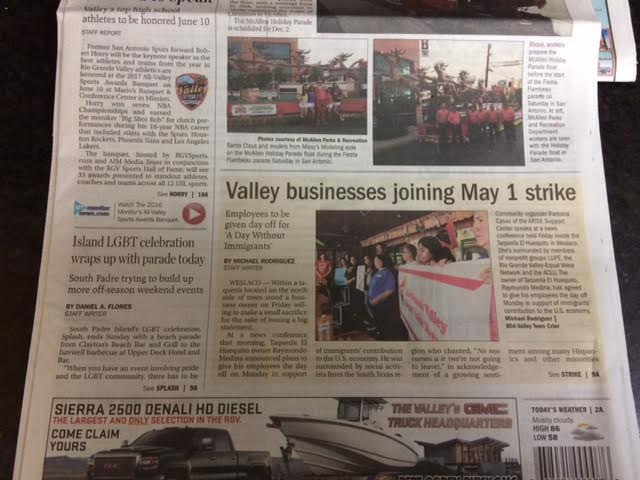
The main story package was not an in-depth investigative, interpretive or analytical piece, but rather at five-paragraph, five-inch-long, "Staff Report" story revealing that a float normally featured in the McAllen Christmas Parade had been carted up to San Antonio for the 2017 Fiesta Flambeau Parade. The story -- which read pretty much like a press release -- was accompanied by three really bad (and badly reproduced) handout photos provided "courtesy of McAllen Parks & Recreation" department. In Steve Fagan's Monitor, this would have been a single photo and cutline probably inside the Valley & State section, but certainly NOT on the main package on Page 1.


One of the other three Page 1 stories -- also bylined as a "staff report" -- announced that former San Antonio Spurs forward Robert Horry would be the keynote speaker at the 2017 All-Valley Sports Awards Banquet, an even sponsored by The Monitor and its parent company AIM Texas Media, which also owns the Brownsville Herald, El Nuevo Heraldo, the Valley Morning Star in Harlingen and the weekly Mid-Valley Town Crier.

A third story was a piece headlined "Island LGBT celebration wraps up with parade today." This  story had some promise particularly if it had dealt, at least somewhat, with the issue of LGBT discrimination in Texas -- which has long been pretty rampant -- and where it stands as we rapidly descend into becoming Donald Trump's bigoted America. It could have featured, maybe, some interviews with actual participants in the event and their feelings on where things are headed with LGBT rights, etc. It, however, didn't and ended up reading more like a South Padre Island Chamber of Commerce press release.


The last story on the page, headlined "Valley businesses joining May 1 strike," had the most potential. In fact, in terms of its topic, it could have been the main story package for the Sunday paper. But it fell woefully short because, apparently, no one recognized its potential for being something better than it was or, if they did recognize that potentially, they simply didn't care enough to push to develop it. Hispanic organizations across the United States are calling for a nationwide "Day Without Immigrants" (Una dia Sin Immigrantes) strike to call attention to the importance of immigrants in the United States' society and economy and to decry the immigration policies and attitudes of Donald Trump, his administration and the Republican controlled Congress. This could have been a meaningful, Valley wide story that took a serious look at immigrants and the roles in America. This area, after all, is something like 90+ percent Hispanic in population and tens of thousands of people here are immigrants both legal and undocumented and hundreds of thousands are descendant of immigrants. Here, a strike by a significant number of immigrants and their supporters who grind everything to a complete standstill. This story could have explored how many area businesses are going to support their employees' participation in the strike and how local government officials, chambers of commerce, schools, the University of Texas Rio Grande Valley, South Texas College, etc. view the strike. The story could have included interviews with workers, students, etc. who are planning to participate in the strike and what message they are hoping it will send and what good they think it might actually accomplish. It could have been a very strong Sunday package including photos of the anticipated participants, perhaps with strike placards they are making or have already prepared. But to have carried that off would have required that someone be awake at the switch, which didn't happen. The story instead was simply coverage of a press conference in which two businesses said they are supporting their workers who might want to participate in the strike -- a disappointing piece full of unrealized potential.

Essentially, the Sunday edition of The Monitor, published on the fourth anniversary of my retirement from newspapering had a front page that gave readers absolutely no reason to pick it up off the lawn and certainly no reason to buy a single copy newspaper off a rack. And a such is unfortunately way too representative of what's wrong with too many newspapers today.


Yep, "it's not Steve Fagan's paper anymore."


-30-


Thursday, May 7, 2015

ARE COWS BECOMING TOO SACRED FOR TOO MANY OF TODAY'S TROUBLED NEWSPAPERS?

My friend Michael H. Price, who I worked with many years ago at the Fort Worth Star-Telegram, posted this provocative early 20th Century cartoon, by socialist editorial cartoonist Art Young, depicting the newspapers of the time as brothels:


With the posting, Mike wrote: "The newspaper racket as a brothel. True enough at the start of the 20th Century, when Art Young published this cartoon, and truer in the Great Here & Now. Exceptions all along, of course, but fewer and fewer exceptions. Too much Bread & Circuses, and nowhere near enough provocative substance."

I really wish I could disagree with Mike, but, frankly, I think the sentiment expressed in this cartoon is just as accurate today -- with newspapers continuing to suffer financial hardships due to declining advertising revenues -- as it probably was then. Perhaps even more so.

I've touched on this topic before, in my Feb. 13, 2015, post "NEWSPAPER ETHICS: MAINTAINING (OR NOT) THE LINE BETWEEN DOLLARS AND SENSE," which you will find still available among my older blog posts.

Many of today's papers have seemingly accorded "scared cow" status to large local advertisers -- who seem to have no qualms about using the weight of their advertising dollars to bully publishers and editors -- and to prominent local people, business leader and particularly vocal groups in their communities who raise objections to certain kinds of content.

Once upon a time, back when newspapers were making higher profits than almost any other industry in the United States, most reputable newspapers took great pride in contending they had no sacred cows.

Prominent among those newspapers was afternoon Louisville Times -- where I took my first, post-college reporting job in 1970 -- and its morning sister publication, The Louisville Courier-Journal. But even then and even there, the "no sacred cows" contention wasn't exactly true as I learned when I wrote a story about Democrat Louisville Mayor Dr. Harvey I. Sloane not paying several years worth of a state tax (the exact title of which I can no longer recall) that applied only to those who, like Sloane, were extremely wealthy.

I knew Sloane was good friends with the also very wealthy Bingham family, owners of the papers at the time, who had thrown their full and the newspaper's full support behind his bid to become mayor.

By the time I turned in the story to the city desk the evening before it was to be published in the next afternoon's paper, I had all of my facts confirmed and double checked and even had the mayor acknowledging that he'd "overlooked" the payments due under the tax and his promise that he would immediately make good on what he owed.  My editors and I figured that with all of this nailed down, the cozy relationship between the Binghams and the mayor wouldn't matter when it came to publishing a story about him being significantly delinquent -- we're talking many tens of thousands for dollars delinquent (over the intervening 40 some years I can't recall the exact amount, but I think is was something like $72,000 and change) -- in the payment of any rightfully owed tax.

We were wrong.

When my story was published in the day's first edition, it appeared stripped six-columns across the top of the front page under a large headline that said something like "Mayor fails to pay $72,000 in taxes."

When copies of the first edition hit Publisher Barry Bingham Jr.'s desk, our managing editor, apparently got a call from Barry Jr. raising cain over the story.

As a result, in the day's second edition, the story was moved to the bottom of the page, with the same headline. But that apparently didn't salve Barry Jr.'s state of pisstivity. He didn't want the story on Page 1, period. In addition, Bingham contended that the story was minimalized by my high-up sentence explaining that the particular tax Sloane owed only applied to the very wealthy.

So, by the day's final edition, the story had been moved to a page deep inside the local section under the headline "Mayor fails to pay obscure tax."

As a reporter and then editor at other newspapers where I worked throughout most of the rest of my more than 44 year career, I encountered similar experiences, even though most of those papers also took great pride in saying they had no sacred cows.

Of course, I did enjoy and number of instances where advertisers or prominent individuals and/or business leaders were told that their dollars or their influence were not going to interfere with the publication of valid news stories.

One such instance occurred while I was assistant managing editor for news and projects at the Fort Worth Star-Telegram in connection with the Bell Helicopter series that went on to win the 1985 Public Service Pulitzer Prize. The series dealt with a design flaw in some of the helicopters that Fort Worth-based Bell Helicopter built for the U.S. military. In the five-day series, Washington Bureau Reporter Mark Thompson revealed the design flaw -- which led to an in-flight phenomenon called "mast bumping" -- had caused the deaths of nearly 250 service men between 1973 and 1984 and that it had gone uncorrected even after Bell's chief attorney brought it to the attention of company executives in 1979 and recommended the problem be fixed immediately.

The series, which began its five-day run on Sunday, March 25, 1984. enraged Jack Horner, president of Bell, which was the city's single largest employer. On Monday morning the furious Horner called to speak to Publisher Phil Meek, who was out of town. So he settled for screaming over the phone at Executive Editor Jack Tinsley, demanding the series be immediately halted, that the people responsible for it be immediately fired and that a top-of-the-front-page apology to Bell Helicopter be published across six-columns of the Tuesday paper, or else.

Tinsley called me -- as the editor responsible for overseeing those who produced and did the primary editing on the series and for actually putting it in the paper -- into his office. Frankly, I fully expected to be fired.

However, Tinsley told me he had reached Phil Meek by phone and informed him of Horner's demands.

"I asked him what I should tell Horner and Phil told me to tell Horner to go fuck himself. So, that's pretty much what I did," Tinsley told me. Although, by that afternoon, all of our single-copy sales boxes on Bell property had been ripped up and tossed outside the plant gates and a group of Bell employees had begun picketing outside the newspaper, the series continued and my job, Thompson's job and job of State Editor Roland Lindsey, who directly oversaw Thompson, were safe. Here is a link to the stories that were part of the series, which I still think is one of the finest examples of quality American journalism: https://sites.google.com/site/mthompsondc/star-telegramseries.

Considering the financial condition of most newspapers, I wonder how many of today's publishers would come up with that sort of response to livid complaints from an important advertiser, business leader or heavy hitting employer.

I fear the answer is not very many.

Certainly, during the waning years before my retirement as editor of The Monitor in McAllen, Texas, and departure from the newspaper business, I experienced several incidents in which important local advertisers where allowed to directly browbeat me, call me unethical and irresponsible and even accuse me or one or more of my reporters of taking payoffs during meetings called to let them bitch about things published in the newspaper that they didn't like.

And, as I communicate with editor and reporter friends who still are employed at other newspapers around the country, I hear more and more tales of such incidents in which outside influencers are allowed to successfully interfere with what gets published in their papers. The main reason usually being cited is fear of lost advertising revenue. The consequence, valid and important news stories with, as my friend Mike Price put it, "provocative substance" -- and even online comments from readers on some stories that do get published -- are being thwarted.

The result: As more of these sorts of things happens, readers lose faith and trust in their newspaper, which loses relevance for them. And we all know what happens when people no longer feel their newspaper is relevant in their lives.

-30-

*******

If you enjoy reading my blog, please share it and its link with your friends and colleagues.

********
I sure would appreciate if you'd consider subscribing to or following the blog. It's easy to do and there are several options for doing so. If you look on the right side rail, you'll see the "Subscribe to" buttons and a "Subscribe by email" button. Just click any of those and follow the instructions. If you are a Google+ user you can click on the "Follow" button right under my profile picture and follow the instructions. Or, you can click on the "Google+ Add to Circles" button next to my photo and add me to your circles and get notifications of new blog entries when I post them. Thanks for giving this consideration.

As always, your thoughts and/or comments are welcomed.


Thursday, April 30, 2015

TWO YEARS INTO RETIREMENT, THE NEWSPAPER-CAREER MEMORIES, GOOD AND BAD, STILL FLOW

As I approached this day, April 15, 2015, the second anniversary of my retirement after nearly 12 years as editor of The Monitor in McAllen, Texas, and at the end of a more than 44-year career in the newspaper business, a flood of disjointed memories has been washing over me -- many wonderful and others not so much.

Over the past two years, the thing that has surprised me most is that I haven't really missed the job nearly as much as I thought I would. This impresses me as quite odd since I always regarded newspapering as more of a way of life than just a job. It was, at least for most of my career, something that you invested yourself in even though you knew that no matter how much you loved a newspaper, it would never love you back, and that as places to work, all newspapers sucked, but many sucked much worse than others.

Before I retired, I used to frequently say the once I did step out of the business I expected to die within three months from lack of stress.

Well, here it is, two years later, and I'm still here and what remains of the business for me is my memories, weird highlights of which have been almost magically washing over me since Tuesday.

It think that what sparked my Magical Mystical Memory Tour was a photo that popped up Tuesday on my Facebook timeline under the heading (oddly enough) of "Your Memories." It was a post I had put up on April 28, 2013, two days before my retirement. The post consisted of a photo of my barren-looking office at The Monitor after I had carted off about eight to 10 boxes of my personal stuff and a cutline. Here is what I had written:

"The only personal possessions now remaining in my office at The Monitor are my Monitor coffee mug, a few packets of sweet n low and what remains in the bottom of a Coffeemate container. Oh yeah, and 11 years and nine months of mostly great memories."

And, here's the photo:


Then, several hours later on Tuesday, the wonderfully witty Michael H. Price, who had been a feature writer and reasonably renowned film critic at The Fort Worth Star-Telegram before, during and after my tenure there -- first as business editor, then assistant managing editor-news and projects and finally night managing editor -- put up a Facebook post that drew comments from a number of former Starlegram staffers, many of them also named "Mike" or "Michael."

That immediately brought to mind the fact that will I was at the Star-Telegram, I was impressed at the overabundance of Mikes in the news department. There was not only Mike Price, but also, to name just a few, Mike Perry, Mike Strickland, Mike Gerst, Mike Norman. Here a Mike, there a Mike, everywhere a Mike, Mike.

I recalled thinking the if I walked into the newsroom and screamed "MIKE," more that half of the guys would look up, including even Sports Editor Jimmy Walker, who may not have been a "Mike" but sure as hell wouldn't want to miss out on a share of anything good that might be coming the way of the Mikes.

That was the first of the disjointed memories that have been coming not so much as long, drawn out episodes, but rather as quick and sometimes, often downright weird, snapshots of a more than 44 year career of doing something I truly loved.

Here is just small fraction of the other career recollections that have been rumbling in my head since Tuesday:

In another Star-Telegram memory, I recalled a mid-April 1985 afternoon huddled in the paper's small "wire room" with Executive Editor Jack Tinsley, Assistant Executive Editor Phil Record and several others as our news service teletypes clickety clacked away while we nervously awaited word on the winners of that year's Pulitzer Prizes.

Although the winners are supposed to be secret until actually announced by the Pulitzer Board, there always seems to be leaks. Two days before, I had been informed by two "sources" that Star-Telegram Washington Correspondent Mark Thompson was to be awarded the Investigative Reporting Pulitzer for his series revealing that at least 250 U.S. service men had lost their lives due to a design flaw in Bell helicopters built in Fort Worth for the military.

I was more nervous than any of the other assembled editors because I had relayed the information from my sources to Publisher Phil Meek, who had enough faith in what I'd told him to set in motion a plan for a celebration costing thousands of dollars.

That morning, however, I got calls from both sources who regretted to inform me they had learned that the Investigative Pulitzer would go to reporters at The Philadelphia Inquirer, NOT to Thompson. I decided to not pass THAT information along, opting to be fired after the announcement rather than earlier in the day.

As it turned out, my sources were right, Thompson didn't win the Investigative Reporting Pulitzer. Instead, The Star-Telegram was awarded the 1985 Public Service Pulitzer, journalism's highest and most prestigious award. The celebration -- which might be better described as a gala with two live bands, loads of catered eats and hundreds of bottles of champagne -- went off as scheduled and I kept my job as assistant managing editor for news and projects. What's more, I was left suspecting that Phil Meek may have had better sources than mine.

Another memory that reared up was from my tenure as metro editor at The Clarion-Ledger in Jackson, Miss. This one from a Monday in 1978, the day after we published a Sunday tabloid special section called "North Mississippi Justice," a massive investigative undertaking spearheaded by reporter Rick Tulsky, who later -- as a reporter at The Philadelphia Inquirer -- won the 1987 Investigative Reporting Pulitzer. The special section provided a very detailed, in-depth look into the circumstances surrounding the unsolved murders of numerous African-American men in North Mississippi and the Ku Klux Klan's apparent involvement in many of them.

The Monday following Sunday's publication of the special section, I started getting the "how-dare-you" phone calls, lots of them, from irate white readers. All of whom were upset not about the murders, but about the fact the we had exposed the racist reasons behind their having gone unsolved for years. Finally, after probably answering at least 100 calls, I had had it. The next call was from an ignorant (there, I said it) sounding woman with a very heavy Mississippi drawl. It went something like this:

CALLER: I'm tired of this, y'all are turnin' this into nothin' but an (n-word) paper. Nothin' but stories about (n-words) and pictures of (n-words). Everywhere I look nothin' but (n-words). Y'all ain't become nothin' but a bunch of (n-word) lovers.
ME: Ma'am, sorry but I really don't care to listen to this any longer.
CALLER: Why?
ME: Well, because I'm black.
CALLER: (After a protracted pause) Oh, uhhhh...I'm sorry (Click).


I never knew whether she was sorry for what she had said, or sorry for me because she thought I was black.

That memory churned up another, somewhat related recollection, of the mind games I was sometimes forced to play with then Clarion-Ledger owners Robert Hederman Sr., who was publisher, and Thomas Hederman, who carried the title editor-in-chief. Both, though well educated (Tom even had a masters degree in journalism from Columbia University), were inveterate racists who would from time to time call me downstairs to their offices to grouse at me over the number stories and, in particular, the number photos we published regarding "minorities" engaged in something other than criminal activity. I think they liked to use the word "minorities" to pretend to themselves that they weren't really racists. Typically, I would just nod my head, say "I understand" and then go back upstairs to continue ignoring with they said.

However, after one particularly brutal downstairs session, I decide to put an end to such discussions which I knew were bogus because it was quite obvious to any objective person that the paper still ran far more stories about and photos of white people than black. So, after being drubbed while I remained silent for at least 30 minutes, I finally spoke up. "I guess what you're saying is that number stories and photos we publish dealing with white and black people should reflect the racial demographics of the city?"

Mr. Bob and Mr. Tom -- as they were referred to, in Southern fashion, by every newspaper employee -- readily agreed that that was precisely what the wanted..."to be fair." Apparently, they did not realize the Jackson's population was, at that point, somewhere between 48 and 49 percent African American.

I promised them that I would do a thorough study of the paper's story and photo coverage whites and blacks compared to the local demographics and get back to them on Monday of the following week.

That weekend, I took home two months worth of newspapers to perform an extensive story and photo count with the help of a brand new bottle of Wild Turkey 101.

First thing Monday morning I went downstairs to inform Mr. Bob and Mr. Tom of the results of my perusal of the two months of papers. They listened intently and smiled as I informed them that contrary to prior beliefs, during that period just barely 30 percent of the stories and photos the paper had published dealt primarily with black people.

I concluded my presentation saying: "It appears -- in accordance with what you told me last week that you wanted the story and photo content to be more representative of the city's demographic breakdown, which is now about 49 percent black to 51 percent white -- that we need to work harder to increase our number of stories about and photos of our black residents."

Mr. Bob quickly responded saying: "Uh, uh, no, no, that's all right. I think we just need to proceed as we have been doing."

I went back upstairs and never again heard another word from either of them regarding our percentage of white to black coverage.

Of course, when you're hit with a flood of memories, some are of embarrassing moments. During my career, one of the most embarrassing moments came on the night, in 2003, we started up the new, very expensive,"state-of-the-art" Goss press installed at The Monitor's new, more than 100,000 square-foot building.

Although neither the newspaper's then General Manager Stephan Wingert, who over saw the construction from start to finish and is now publisher, or then Publisher Olaf Frandsen had at that point ever been party to the installation and start up of a new press. I had. While I was there, new presses were installed at The Clarion-Ledger, at the Fort Worth Star-Telegram and at The Morning News in Florence, S.C.

I learned from experience all three of those installations that, no matter what, when you first try to kick those new presses into high gear, SOMETHING is invariably going to go wrong. Therefore, it's usually a good idea to run them for a couple of nights putting out the paper before you make a big public announcement and invite a bunch of local dignitaries in for the GRAND start up.

I passed that information along to Stephan and Olaf, who carefully listened to what I had to say and then ignored the advice, relying instead on assurances from the still on-site Goss technicians who anticipated that things would go smoothly and glitch free right from the git go.

Boy, were they wrong.

The night -- after a large, ill-advised front-page story in that morning's paper proudly announced that the next morning's edition would be printed on the much-heralded new press -- the monster was fired up to produce the actual run of the paper for the very first time. Our beautiful new, totally computerized, state-of-the-art press room was crammed full of local muckety-mucks, one of whom was even accorded the honor of pressing the start button.

At first things went fine with the presses running at slow speed and everyone was all smiles and back slaps. But as the speed began to pick up, the web breaks started happening and the Goss techs started tinkering. It seemed like the more they tinkered, the worst things got.

As it turned out, the first edition of The Monitor, printed on that much-heralded new press didn't get delivered to readers' homes until well after 3 p.m. There wasn't a steak big enough to soothe that newspaper black eye.

Oops, told ya so.

Another, personally more embarrassing moment came while I was editor of The State Journal-Register in Springfield, Ill., involving a political endorsement I was obliged to write for a candidate for the Lincoln Land Community College board of trustees. At the time, the newspaper was owned by now defunct Copley Newspapers, all of which were required to endorse only Republican candidates -- so much for the "liberal media" myth. Although I make no bones, particularly now, about being a lifelong Democrat and liberal, it was sometimes not too awful having to endorse some Illinois Republicans like former Congressmen Ray LaHood and his predecessor Bob Michel, both of whom were good, moderate politicians. LaHood went on to serve as President Barack Obama's first Secretary of Transportation.

However, the Republican candidate for the Lincoln Land board of trustee was not cut from the same cloth as Michel and Hood. At this point I no longer remember his name, but he was an assistant director of the state Department of Human Services.

To be honest, under most circumstances I would not have been all that upset about being force to endorse a community college board of trustees candidate who I probably wouldn't vote for on a bet because, frankly, that was an elected position I really didn't care that much about.

However, in this instance, the circumstances were anything but normal. In this case, the GOP candidate was under federal indictment for directing millions of dollars in state contracts from his department to a computer services company operated by his wife that did not properly perform the work as specified in those contracts but still collected the money. At first I spoke out against endorsing him but was finally forced to do so by SJ-R Publisher Jack Clark. It was not one of my prouder moments in journalism.

Fortunately, the candidate was convicted and went to prison before he could take his seat on the community college board of trustee.

I think ever newspaper probably gets more than it's share of callers who are mad. I don't mean readers who are angry and want to take the paper to task for something that appeared in that day's edition. I mean mad, nuts, borderline or certifiably insane. People who live their lives in some bizarre alternate universe of their own making.

For many of us working at The Louisville Courier-Journal & Times in the mid-70s, one of the most familiar telephone wackos was a woman known to us only as "Dixie." For some reason, a lot of her calls used to find their way to me. Over time, Dixie apparently decided we were pals, maybe because I usually tried to be polite and listen to her at least for a little while before saying I had to go and maybe also because I once made the mistake of giving her my name.

Dixie was never nasty or threatening. Instead, she was almost always frantic because "they" were after her because of the "secrets" only she knew. Mostly she called when she was sure that "they" were hiding under her house waiting to either grab her when she came out or were trying to saw their way up through her floor. "They" also sometimes sent her secret, threatening messages over the country music station she listened to regularly.

At the time I was getting the frequent calls from Dixie, I was the county government reporter for The Louisville Times, the now-defunct afternoon edition of the sister papers.

One afternoon when I was working feverishly to finish writing a rather complex breaking news story for our final edition I got a call from Dixie who said she was at they very moment receiving one of those radio messages from "them" and she wanted me to hear it for myself. I told her as politely as I could that I really didn't have time to listen to the message because I was trying to meet a deadline, but she would have none of my excuses. She turned the radio up full blast and put her telephone receiver down next to it.

"Please, Dixie, hang up the phone and call me later when we can talk," I screamed into my receiver. But, it was no use, she couldn't hear me over the radio. So, I hung up on her and waited a few minutes make a much need call to a source on my story, but when I did, instead of getting a ring tone, all I heard was Dixie radio still blasting away at maximum volume. This was back in the days before you got an automatic disconnect a second or so after hanging up your receiver. After picking up the phone several more times in an effort to place my critical call only to find the music still blaring, I finally moved to the desk of one of my fellow reporters who was out in the field, made my call and finished writing my story. For the rest of the day, I kept picking up my phone receiver only to find the music still playing. It wasn't until sometime after 4 p.m. that Dixie finally returned to her senses and hung up on her end. I was pissed.

The next morning, I called a police detective friend to see what I could do about Dixie. I told him, without naming her, that I was getting phone calls from a head case and related what she had done to me the day before. He asked if I felt that she was a threat. I told him no, and explained that she mainly called seeking help to protect her from the people hiding under her house waiting to harm her.

"Ah, sounds like Dixie," my detective friend said.

"Yeah, that's her name, Dixie. How did you know that," I replied.

"We get calls from her, too, coming into the Detective Bureau. She's harmless. We usually just let her talk for a few minutes and then promise that we'll send someone out to check on those guys under the house. That usually satisfies her for a while,"  my detective friend told me.

"We accord her more courtesy than we might to other crazy callers because of what she's been through," he added.

He went on to explain that Dixie had been one of the Bataan nurses who was captured by the Japanese after our besieged, beleaguered, starving and nearly out of ammunition troops finally had to surrender the Bataan peninsula in the Philippines at the start of World War II. He said that she and the other nurses were interned in prisoner of war camps in the Philippines where many of them were beaten and raped. Dixie, along with many of the other nurses, was eventually transferred to Japan where she was interned until VJ Day, he said.

"We're the battling bastard of Bataan, no mama, no papa, no Uncle Sam. No aunts, no uncles, no cousins, no nieces, no pills, no planes, no artillery pieces. And nobody gives a damn, nobody gives a damn" -- Frank Hewlett, 1942.

After that, every time I got a call from Dixie,  I treated her with renewed respect, listened for a few minutes to what she had to say and then promised I would call the police department and have them send someone to her house to scare away the men hiding under it. That always seemed to satisfy her and we'd hang up on good terms.

As I sit here now, thinking about Dixie and the dreadful memories she must have had, I'm getting depressed.

But, my recollections of her, also make me grateful for the multitude of mostly wonderful memories I have of my more than 44-year newspaper career.

-30-


*******

If you enjoy reading my blog, please share it and its link with your friends and colleagues.
********
I sure would appreciate if you'd consider subscribing to or following the blog. It's easy to do and there are several options for doing so. If you look on the right side rail, you'll see the "Subscribe to" buttons and a "Subscribe by email" button. Just click any of those and follow the instructions. If you are a Google+ user you can click on the "Follow" button right under my profile picture and follow the instructions. Or, you can click on the "Google+ Add to Circles" button next to my photo and add me to your circles and get notifications of new blog entries when I post them. Thanks for giving this consideration.

As always, your thoughts and/or comments are welcomed.


Thursday, March 5, 2015

ALLEGED DRUNK DRIVER'S ACCIDENT WITH SCHOOL BUS LEAVES LOTS OF QUESTIONS FOR RIO GRANDE VALLEY MEDIA OUTLETS TO ANSWER

On the bottom right hand corner of Page 3B in this morning's edition of The Monitor in McAllen, Texas, and on the newspaper's website, www.themonitor.com, is a story that should be garnering a lot more local media attention than it apparently has so far.

The story involves Alexander Correa, 23, of Edinburg, one of McAllen's numerous neighboring cities, who, on Monday morning, plowed into the back of a school bus with, according to the newspaper report, 10 students on board. Fortunately, no students were injured.

If that was all there was to the story, it, frankly, wouldn't be all that big of a deal. Accidents in which there are no injuries, even ones involving school buses, happen everyday and most go without so much as a passing mention in the media.

But this accident was not that simple because police ended up arresting Correa on charges of driving while intoxicated -- his sixth such charge in less than two years, the paper reported. Here is the link to the story posted at 7:16 p.m. on Wednesday on The Monitor's website: http://www.themonitor.com/news/local/edinburg-man-gets-sixth-dwi-in-years-after-crashing-into/article_fd0f16f4-c2d5-11e4-85e7-177a259d7b63.html.

The story was reported earlier in the day by the area's English-language Fox affiliate TV station KXFV, which even had video of Correa's arraignment in Edinburg Municipal Court before Judge Terry Palacios. Here is a link to that report: http://www.foxrio2.com/repeat-drunk-driver-slams-into-bus-filled-with-middle-school-children/.

To their credit, The Monitor and KXFV were, as of 8:30 CST this morning (Thursday, Mar. 5, 2015), the only area news outlets reporting this story.

I suspect that by the end of the day, this could wind up being the news story that is the most talked about by Rio Grande Valley residence once the news departments at the area's other English-language TV stations -- KRGV, KGBT and KVEO -- finally get around to looking at The Monitor's Page 3B and KXFV's website and begin playing catch up.

I hope that all of the local media take out after this story the way they should and don't -- as is so often the case here and in far too many other communities around the nation -- just let it drop until Correa's trial, which may or may not be covered live by any of the local media outlets.

My old friend, Bill Marimow, editor of The Philadelphia Inquirer, alerted me to a story his paper published in September that could serve as a great guide for Rio Grande Valley media to follow if they want to do a high impact followup story on this accident. The Inky story deals with Pennsylvania's pretty abysmal record for keeping repeat drunk drivers off the roads. Here is the link: http://www.philly.com/philly/news/20140907_Despite_tougher_Pa__DUI_laws__many_repeat_offenders_stay_on_the_road.html

Hopefully, The Monitor, or one or all of the TV stations, will very quickly follow up by giving the details of Correa's other five DWI cases, one of which was dismissed and the other four of which are yet to be adjudicated. The Monitor's and KXFV's reports mentioned the other cases but gave no details regarding when they occurred,  where they occurred, what was involved or where exactly they stand in the judicial process.

Beyond that, there are still many questions to be answered with regard to this incident, which I am still rather surprised was not played at least on the front of the Valley & State (B) section of The Monitor.

I think the question that will be most on the minds of those area residents who take note of the story is why in the world Correa, with five prior DWI arrests, continues to have driving privileges. That's an important question that must be put to the area law enforcement agencies that have arrested him and to the judges and prosecutors who are handling, or in the past have handled, the cases against him.

Jeff Allen Lindau, who commented on the story on The Monitor's website quite rightfully and fairly said, "the media could probably trace the reasons this person is still driving and hasn't been convicted on any of his previous 5 charges of DWI. The question is will they get to the bottom and expose it?"

In another comment on the story, Lindau said: "All one has to do is research DWI's in Hidalgo County and you'll see our county has one of the highest rates of DWI incidents with one of the state's lowest rates for prosecuting DWI offenders. The local media half heartedly has looked into these numbers in the past but never fully held the DA's office accountable." Although he is substantially correct, Lindau failed to mention that the area's judges who handle drunk driving cases should perhaps be held even more accountable than area prosecutors since, in the final analysis, it is up to them to determine the punishments handed out to first- and multiple-time DWI offenders.

Lindau is also on point with his offhanded bash at the local media for only "half heartedly" looking into the drunk-driving issue in the Rio Grande Valley, where it seems to be a serious problem considering the number stories on DWI accidents, many involving multiple injuries and fatalities, that are reported here every year by The Monitor and area TV stations.

As much as I hate to admit it, even I have to plead guilty to Lindau's charge of media half-hearted reporting on the area's drunk driving problem.

There were several times during my nearly 12 years as editor of The Monitor -- usually after a particularly horrendous DWI accident -- that I considered having my reporters launch a full-scale examination into how drunk driving cases are handled, or mishandled, in the Rio Grande Valley, but failed, for whatever excuse, to not follow up on.

In retrospect, I consider myself particularly remiss in not having done so since I had considerable experience with such projects at papers where I had previously worked. As the courts reporter for The Louisville (Ky.) Times in the early 70s I produced a several-day series of stories on lenient handling of DWI cases by judges in the area's municipal courts. As managing editor of The Clarion-Ledger in Jackson, Miss.; and later The Cincinnati Post; and then as editor of The State Journal-Register, in Springfield, Ill., I directed examinations of how drunk-driving cases were handled by the courts and even identified the top 10 to 20 repeat DWI offenders in those cities. In fact, our drunk-driving series at The State Journal-Register resulted in me being invited to speak at that year's national convention of Mother Against Drunk Driving (MAAD) in Washington, D.C.

I urge my former area media colleagues to not follow my lead. Don't let this opportunity to take a serious look at how the many drunk driving cases are handled by the judicial systems in the Rio Grande Valley. Let this case be the impetus for an in-depth look into the issue by one or all of our area media outlets because lives are at stake and law enforcement, prosecutorial and judicial feet should and must be held to the fire and repeat offenders, in particular, need to be exposed and prevented from killing themselves and/or innocent potential victims.

Thanks to the expansion of computerized record keeping by area courts, the task should be much easier now than it was in the past, when reporters had to go through the tedious task of reviewing hundreds of pages of sometimes handwritten court dockets to identify and track such cases. That's the upside.

The downside is that due to the fees public agencies are allowed to collect under Texas law, accessing those records could cost hundreds, if not thousands, of dollars -- a factor that has put a serious crimp in investigative reporting by all but the state largest newspapers and television stations.

That considered The Monitor and one or more of the local TV stations might want to think about joining forces to not only devote the sort of reportorial resources need to produce a meaningful and game-changing examination of the issue, but also to share and defray the costs of the undertaking. As leery as I am of the concept (see my Feb. 13, 2015 post "NEWSPAPER ETHICS: MAINTAINING (OR NOT) THE LINE BETWEEN DOLLARS AND SENSE) this might just be one of those rare instances when one or more media outlets might consider seeking crowdfunding from readers and/or viewers to help finance a project that is -- or certainly should be -- a matter of significant public concern.

-30-


********
If you enjoy reading my blog, please share it and its link with your friends and colleagues.
********
I sure would appreciate if you'd consider subscribing to or following the blog. It's easy to do and there are several options for doing so. If you look on the right side rail, you'll see the "Subscribe to" buttons and a "Subscribe by email" button. Just click any of those and follow the instructions. If you are a Google+ user you can click on the "Follow" button right under my profile picture and follow the instructions. Or, you can click on the "Google+ Add to Circles" button next to my photo and add me to your circles and get notifications of new blog entries when I post them. Thanks for giving this consideration.

As always, your thoughts and/or comments are welcomed.

Wednesday, February 11, 2015

BORDER NEWSPAPERS NEED TO MAKE IT VERY CLEAR WHERE INCIDENTS OF DRUG VIOLENCE OCCUR SO THEY DON 'T SCARE THE LIVING BEJESUS OUT OF READERS

I wonder how many other online readers of The Monitor, based in McAllen, Texas, had a lump rise in their throats on the morning of Jan. 28 when they read this headline "GUNFIGHT BETWEEN CARTEL GUNMAN AND STATE POLICE ENDS IN ARRESTS" on the newspaper's website.

Of course, seeing that The Monitor is a Texas paper, my immediate impression was that the spillover violence is getting worse than I thought when Texas State Police officers end up in a "gunfight" with Mexican drug cartel members.

Reading the lead of the story didn't clarify things much: "State police arrested two men after a gunfight on Monday, according to a news release."

Having been the editor of The Monitor for nearly 13 years before my retirement in May 2013, I know the state police in Texas issue loads of press releases. So reading that lead didn't help.

It wasn't until I got to the second paragraph that I was able to breathe a sigh of relief upon finally learning that the "state police" the story was talking about was, apparently, the state police in Tamaulipas, Mex. I say "apparently" because no where in the story -- attributed in the second paragraph to a press release from the "Tamaulipas attorney general's office" -- does it specifically say that it was the Tamaulipas state police who were involved in the gunfight which you learn still later in the story occurred on the Mexican side of the border "along the Mier-Miguel Aleman highway."

Seems to me that in reporting on violence involving Mexican drug cartels, the numerous newspapers along the US-Mexico border from Texas to California have a special obligation to make quite clear from the outset (as in the headlines and certainly the leads of stories) where the outbreaks of violence they are reporting on occurred.

The numerous, and seemingly increasing, outbreaks of drug violence in border areas makes residents on the US side justifiably nervous and worried about the possibility of spillover. Border newspapers need to report on the violence when they can, but in doing so, I think they are also obliged to make it very clear, beginning with their headlines, who's "state police" are involved in "gunfights" where.

Clarity in reporting and headline writing is every bit as important as accuracy.

Here is the link to The Monitor story: http://www.themonitor.com/news/local/gunfight-between-state-police-and-cartel-gunmen-ends-in-arrests/article_d4a6a786-a764-11e4-8ae0-37af1e01224f.html

-30-

********
If you enjoy reading this blog, please share it and its link with your friends and colleagues.
********
Blog Readers: If you enjoy reading my posts on The Ancient Newspaper Editor, I sure would appreciate if you'd consider subscribing to or following the blog. It's easy to do and there are several options for doing so. If you look on the right side rail, you'll see the "Subscribe to" buttons and a "Subscribe by email" button. Just click any of those and follow the instructions. If you are a Google+ user you can click on the "Follow" button right under my profile picture and follow the instructions. Or, you can click on the "Google+ Add to Circles" button next to my photo and add me to your circles and get notifications of new blog entries when I post them. Thanks for giving this consideration.
As always, your thoughts and/or comments are welcomed.


Tuesday, December 2, 2014

NEWSPAPER FRIENDS: WHEN LIFE STOPS GIVING AND STARTS TAKING AWAY

UPDATE (1-8-2015): Queenie Pemelton, my friend and my Community Editor for the nearly 13 years I was editor of The Monitor, succumbed to her long battle with breast cancer this evening after more than a month in hospice care. Rest in Peace, Queenie. They simply don't make them like you anymore. 

UPDATE: Sometimes, there really is nothing I like better than good news. My friend, Monitor Community Editor Queenie Pemelton, after having her ventilator removed last night and breathing on her own, has taken a turn for the better. Perhaps prayers and well wishes do work. Either way, there now appears to be some reason for at least cautious optimism.

******


This morning I am reminded of an actually pretty poignant line from the last Indiana Jones movie, "Kingdom of the Crystal Skull:"

"We've reached the age where life stops giving us things and starts taking them away."

For the second time in less than a week, a newspaper friend could to be headed toward the final edition.

Last Wednesday, we lost longtime friend Larry Nighswander, who was my assistant managing editor for photo and design when I was managing editor of The Cincinnati Post, who died of a sudden heart attack. Larry was one of the media's best photo editors and visual educators of the past 30+ years.

Today, Queenie Pemelton, my community editor for the nearly 13 years I was editor of The Monitor, in McAllen, Texas, before my retirement last year, is hanging on by a thread at Rio Grande Regional Hospital. Like Larry, Queenie, 61, is a very special person.

She is a veteran of more than 30 years at The Monitor. And, although Queenie is not a "trained" (i.e., college graduate with a degree in journalism) journalist, she is nonetheless not only the news staffer best known to the public, she is probably the person whose name most often comes to mind when anyone in the public thinks of The Monitor.

For tens of thousands of full-time area residents and part-time "Winter Texans," Queenie -- who came to the newsroom from the back shop and got her journalism training on the job -- personifies The Monitor.

As community editor, a title I crafted for her years ago, her job for more than two decades has been to do the intake, editing and placement of the scores of press releases the newspaper receives every day from a wide variety of community people, groups and organizations from across The Monitor's circulation area, many of them hand delivered by the procession of mostly ordinary people who show up at her desk daily. Although most of these people could just as easily mail or email their press releases about a garden club meeting or a son or daughter receiving special honors at college or graduating from military boot camp, etc., they come in person because they love talking with Queenie, who always gives each of them a few minutes to chat despite her inordinately heavy workload created by the many press releases in need of editing.

To me, Queenie represents one of the things that I've always liked best about The Monitor -- it makes room daily to run many seemingly mundane community press releases dealing with the accomplishments and highly localized interests of thousands and thousands of readers and subscribers and does so not in some segregated "special" publication, but as part of the daily newspaper without in any way "harming" the paper's well-recognized professionalism.

I firmly believe that through her work, her character, her caring and her boundless love for the ordinary folks of the Rio Grande Valley, Queenie, for years, was highly instrumental in helping The Monitor stave off some of the precipitous circulation drops experienced by many other daily newspapers.

But for years now, Queenie has been waging war against breast cancer. For a while there, after several operation and much chemotherapy, many of us thought -- and hoped -- that she had won her battle. However, last week she suffered a seizure that again sent her to the hospital where she ended up being put on a ventilator. A CAT scan, according to information passed along to me, revealed that she had developed five brain tumors that have been ruled in operable.

Yesterday evening, the decision was made to remove the ventilator and although she was breathing on her own afterward, the prognosis is not good.

A mutual friend, who is keeping my updated via text messages, sent one last night that said: "Queenie is no longer the Queenie we know."

But, I beg to differ. Regardless of what happens next, in my mind, Queenie will ALWAYS be the Queenie I have known -- a very special person and a very special brand of journalist.

-30-

Saturday, August 9, 2014

THE ART AND ARGHHHH OF NEWSPAPER HEADLINES

   To my way of thinking, a really well crafted newspaper headline is every bit as much a work of art as a fine painting or a melodic symphony. It's no easy feat to truly and accurately capture the essence of a story in a handful of words and many a copy editor who has tried has failed miserably.
   However, even though the well-craft-headline batting average for most copy editors would never land a baseball player in the hall of fame, I saw many rare gems over my nearly 45-year newspaper career. As an editor, I also saw many a headline that made me want to hide somewhere and not answer my telephone for the rest of the day.
   For an editor, headlines can be a source of great joy or agonizing consternation.
   To be honest, what got me thinking about this this morning was the "headline" someone put on a Twitter post regarding a Kansas City Star story about a Baptist official in Missouri who was arrested for soliciting -- via Craig's List -- sex with a dog or some other animal. It's not a joke, here's the link to the story: http://www.kansascity.com/news/government-politics/article1172168.html.
   The Twitter wag posted the link and wrote this, which essential is a headline: "BAPTIST BUSTED FOR PROFFERING PAY TO PORK POOCH." It's exactly the sort of joke headline a newspaper copy editor might write and then pass around to newsroom buddies for a chuckle and delete before it accidentally makes it into print.
   However, it jogged my memories of one particular incident when a similarly inappropriate and, shall we say, bawdy headline did make it into print while I was editor of The Morning News in Florence, S.C., in 1998.
   The story involved an incident in which a man in a trench coat was standing outside the fence around the field where the West Florence High School girls' softball team was practicing. The trench coat, of course, is a dead give away. The man opened it, flashing the girls while he masturbated. When the coach charged the fence with a softball bat, the man fled and police were called to give chase, but the culprit got away.
   The story, which played on the back page of the Local section, was processed by one of our best copy editors, who, as it happens, also had a wicked, off-color sense of humor.
   When I picked up the paper from my front porch the next morning, I found that she had written, and our copy desk slot person had for some reason allowed to run, this headline: "MAN PULLS FOR HOME TEAM."
   Almost before I could stop choking on my sip of breakfast coffee, I got a less than pleasant telephone call from Publisher Tom Marschel inviting me to come to his office the moment I arrived at work. I got -- and then passed along -- a well-deserved butt chewing and had a devil of time trying to write the mea culpa we ran on the front page the next morning.
   Fortunately, a few weeks earlier a joke headline on another pretty racy story got passed around but didn't make it into the paper. The story was about an area hog farmer who was arrested on murder charge and incest charges after he killed his son when the lad walked in on him raping his daughter. That "suggested" headline was "PIG FARMER PORKS DAUGHTER, KILLS SON." I'm sure glad that I personally put the wooden stake through the heart of that one.
   For me, some of the hallmarks of great headlines are thought, creativity, humor and poignancy. However, sometimes any one, or even all, of those hallmarks can be carried to disturbing extremes.
   Such was the case involving one of the two headlines I remember best from my days as a reporter for The Louisville Times in Louisville, Ky. The story was an Associated Press report on the Aug. 24, 1970, bombing of science lab in Sterling Hall at the University of Wisconsin in Madison, where research was being done for the U.S. military. Four anti-Vietnam War protesters were charged in the incident which resulted in the death of of one physics researcher and injuries to several others. As part of its report, AP noted that Aug. 24 also happened to be the birthday of the young son of the researcher who was killed. The Times copy editor who processed the story seized upon that fact and, in an effort at poignancy, came up with this headline: "HAPPY BIRTHDAY, CHRISTOPHER, YOUR DADDY'S BEEN KILLED BY A BOMB."
   Needless to say, irate callers by the hundreds telephoned Managing Editor Bob Clark to rage over the "insensitivity" of that one.
   But attempts at creativity and/or poignancy often do work and there was one Louisville Time copy editor whose ability to come up with great headlines on a regular basis always impressed me. He was an older fellow named Adrian A. Daugherty -- better known just as "Double A." In those days, most people didn't train specifically to be copy editors as they do today. Instead, most copy editors were long-time, former reporters whose legs had given out out them, but had street savvy they often used to both taunt and help educate young reporters.
   One of Double A's specialties was writing what was referred to in Times parlance as "flash lines," headlines that appeared above the cutlines on stand-alone photos.
   The Daugherty flash line the stands out most in my memory appeared with a photo of two soldiers in Vietnam, under fire, carrying a wounded buddy to safety. Daugherty's flash line: "TAKE TWO, CARRY ONE." It was creative. It was intelligent. It was respectful. It drew you into the photo.
   Of course, trying to inject some humor into a headline, particularly a headline on an otherwise serious story, can get you into real trouble. But sometimes it works. A headline by Pete Oliva, one of my former copy editors at The Monitor in McAllen, Texas, used humor that worked. In fact, it worked so well that it won him a headline writing award in the Texas Associate Press Managing Editors competition. The story involved the Campbell's Soup Co. which for years has used the line "Mmm...good" in its advertising. The story was about a dead rodent being found in can of one of Campbell's soups. Pete's headline: "MMM...MOUSE."
   Sometimes, just playing it totally straight with a headline can leave readers scratching their heads.
   While I was metro editor at The Clarion-Ledger in Jackson, Miss., in the late 1970s we and our afternoon sister paper, The Jackson Daily News, covered a store involving two late-night intruders who broke into a restaurant owned by a local policeman and his family. Two were killed by a hail of warning shots as they exited the eatery via the back window they'd broken in through. The police investigation that followed revealed that the two dead "burglars" were actually investigators for a Congressional committee who apparently broke into restaurant to gather evidence on the police officer/owner who was later arrested on federal charges. The Jackson Daily News' headline on their story about the post -shooting investigation: "POLICE PROBE ACTIVITY OF DEAD SUSPECTS."


-30-

Blog Readers: If you enjoy reading my postings here on The Ancient Newspaper Editor, I sure would appreciate if you'd consider subscribing to or following the blog. It's easy to do and there are several options for doing so. If you look on the right side rail, you'll see the "Subscribe to" buttons and a "Subscribe by email" button. Just click any of those and follow the instructions. If you are a Google+ user you can click on the "Follow" button right under my profile picture and follow the instructions. Or, you can click on the "Google+ Add to Circles" button next to my photo and add me to your circles and get notifications of new blog entries when I post them. Also, please share the blog with your friends and colleagues.  Thanks for giving this consideration.
*******


Your thoughts and/or comments are welcomed.


Tuesday, July 22, 2014

MODERN MEDIA PERIL: NEWSPAPER INTESTINAL FORTITUDE VS. ADVERTISER BULLYING

Renowned media blogger Jim Romenesko (jimromenesko.com) reported recently that Ken Hart, a 25-year veteran reporter for the Ashland (Ky.) Daily Independent was fired over a Facebook post criticizing a local auto dealer's TV commercial featuring his kids "baby talking" about the dealership -- Fannin Automotive.

Hart, who, according to the media blogger, has frequently been critical of such advertisers as Hobby Lobby, with regard to its U.S. Supreme Court birth control coverage case, and Chick-Fil-A, told Romenesko: “It appeared to me [that they] were being coached to talk like babies because it was ‘cute, I [wrote on Facebook] that making them do this was likely to get them teased unmercifully in school.”

The next day, according to Romenesko, Hart was called into Publisher Eddie Blakely's office and fired. Here is the link to Romenesko's full report on the firing: http://jimromenesko.com/2014/07/21/kentucky-reporter-is-fired-for-criticizing-a-local-car-dealers-tv-ads/

Considering how kids are -- despite national efforts to combat schoolyard bullying and teasing -- Hart is probably right, the dealer's kids likely will be teased unmercifully and possibly even traumatically over the commercial when school starts this fall. And that, in my book, makes his Facebook comment fair criticism. It should be noted that he apparently merely criticized the commercial and not the dealership per se.

Speaking in retrospect, Hart told Romenesko:  “Should I have posted what I did? Probably not. Did I deserve to lose my job over it? I personally don’t think so."

From a personal perspective, I think Hart's firing is outrageous. However, I believe that it is, unfortunately, symptomatic of a frightening change in the way the nation's financially troubled newspapers are reacting to bullying by advertisers who see things they object to in the newspaper or on social media posts by news staffer and go off on hell-raising tangents.

I speak from personal experience having, over my nearly 45-year career as a newspaper reporter and editor, frequently (and often unknowingly) gotten crosswise with an advertiser.

The most recent -- and thankfully final -- such incident occurred about 18 months before my retirement as editor of The Monitor in McAllen, Texas, on April 30, 2013. Fortunately, I was working for a great publisher, who on several occasions during the 10 years I worked under him went through hell with advertisers on my and the newsroom's behalf. Had I had a different, weak-kneed, publisher, I might have faced the same fate as Ken Hart.

As it happens, this incident also involved automobile dealerships.

We ran a front-page story on the opening of an upscale auto dealership for a luxury brand new to the Rio Grande Valley in one of McAllen's smaller neighboring cities. Probably because it was a competitor, the story thoroughly pissed off the owner of the metro area's largest group of dealerships that together comprised our single largest local advertiser. He contacted our advertising director and the Publisher Olaf Frandsen threatening to cancel his advertising, contending he never got that sort of play when he opened a new dealership.

In an effort to placate him, Olaf arranged a meeting at the paper among himself, me, our advertising director and the irate dealer and his marketing director. I was forced to sit in silence as the outraged mega-dealer, who I had previously regarded as a friend, browbeat me and called me and my staff "irresponsible and incompetent." He even accused me and the reporter who wrote the story of taking a payoff to run it. In retrospect, we might have (and I repeat "might have," but I doubt it) avoided the problem had the story run on the business front instead of Page 1. However, I believe it deserved the play it was given because the dealership was lured to the neighboring city with incentives that stirred up a controversy in that community. Some of the stories regarding the controversial incentives had run on the front page.

In the end, Frandsen -- who was wonderfully skilled at calming waters without surrendering news integrity -- managed to smooth over the situation. However, as penance, a couple of weeks later, I wrote a story that validly was news that went with a full Business Page presentation announcing that the irate mega-dealer was building a new store to house yet another luxury brand new to the Valley.

I should point out that this was not the first time I had gotten crosswise with this particular auto dealer. For instance, years earlier, he took great offense and caused an uproar when we ran -- on an inside page -- a national wire story that accurately described one of the brands he then carried as Detroit's worst gas guzzler.

Although attempted bullying of newspapers by their advertisers -- and particularly by auto dealers -- is hardly a new phenomenon, it does seem to me that over my last few years before retirement that advertisers became more brazen in their intimidation attempts as papers sank deeper into their economic woes and advertising lineage and revenue shrank.

I believe and fear that newspapers today are far more susceptible than ever to caving in to this sort of pressure designed, in some instances, to force things that are not news into print and keep things that are news out of print.

However, it has not always been thus.

While I was managing editor of The Clarion-Ledger in Jackson, Miss., in the late 1970s and early '80s -- before it was bought by Gannett -- we published a series on unnecessary auto repairs done by both independent auto shops and dealership service departments in the area. We well documented numerous instances where unnecessary and costly repairs were made even by well-respected auto dealership shops.

Although it enraged local auto dealers, Publisher Robert Hederman Sr. and Editor Tom Hederman stood by the series, refusing to stop or retract it. Consequently, the local auto dealers' association encouraged an advertising boycott that most -- but not all -- dealers went along with, resulting in tens of thousands of dollars in lost revenue for the paper.

The boycott, however, only lasted a little over 30 days before the participating dealers realized they were losing more in sales than the newspaper was losing in ad revenue. A group of dealers met with Robert and Tom -- who were not only respectively publisher and editor, but also the owners -- and informed them that they felt that the "lesson" they were teaching the paper had gone on long enough and they were "ready to start advertising again."

As was their southern gentlemanly habit, Robert and Tom politely thanked the dealers for wishing to return to the advertising fold. Then they informed the dealers that since they had not advertised for over a month, their advertising contracts had been nullified and that if they wanted to advertise again they were welcome to do so under new contracts at a 10 percent increase. All sheepishly signed the new, more costly contracts and the newspaper quickly made up for and significantly exceeded the lost revenues.

Simply because they can't afford to, I seriously doubt that many of today's newspaper top executives would display the sort of intestinal fortitude with which Robert and Tom Hederman countered the bullying by those auto dealers. And THAT, in my opinion, is a pretty sad state of affairs.

-30-

Blog Readers: If you enjoy reading my postings here on The Ancient Newspaper Editor, I sure would appreciate if you'd consider subscribing to or following the blog. It's easy to do and there are several options for doing so. If you look on the right side rail, you'll see the "Subscribe to" buttons and a "Subscribe by email" button. Just click any of those and follow the instructions. If you are a Google+ user you can click on the "Follow" button right under my profile picture and follow the instructions. Or, you can click on the "Google+ Add to Circles" button next to my photo and add me to your circles and get notifications of new blog entries when I post them. Also, please share the blog with your friends and colleagues.  Thanks for giving this consideration.
*******


Your thoughts and/or comments are welcomed.